


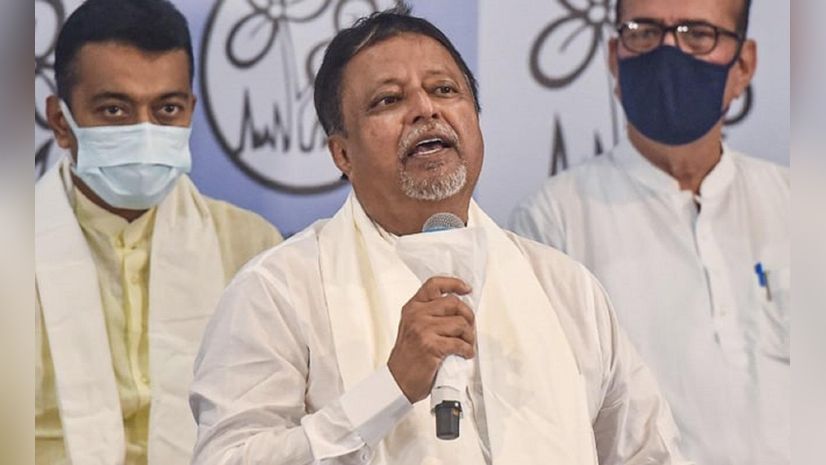

The curtains have fallen on an era in Bengal politics. Veteran leader Mukul Roy, widely regarded as the “Chanakya” of the state’s political landscape, has passed away after a prolonged battle with age-related illnesses. His demise marks the end of a journey that saw a young boy from Kanchrapara rise to become the second-in-command of the Trinamool Congress (TMC).
From Kanchrapara to the Inner Circle
Born on April 17, 1954, Mukul Roy’s political journey began in the ranks of the Youth Congress, where he first met Mamata Banerjee. What started as a political association blossomed into a deep bond; Roy viewed Banerjee as a sister, while she treated him as a trusted brother—a relationship once symbolized by the annual Bhai Phonta (Bhai Dooj) celebrations.
Roy was academically driven, holding a BSc from Calcutta University and later earning an MA in Public Administration in 2006, even as his political career was reaching its zenith.
Architect of the Trinamool Congress
When Mamata Banerjee broke away from the National Congress in 1998 to form the All India Trinamool Congress (AITC), Roy was at the frontline. He wasn’t just a member; he was a founder who lived in the party’s Tiljala office with his family during its leanest years.
His greatest strength was his encyclopedic knowledge of Bengal’s grassroots. From remote booths to urban blocks, Roy knew the pulse of the voters. He played a pivotal role in the Singur and Nandigram land movements, which eventually dismantled the 34-year Left Front rule.
The Rise to ‘Second-in-Command’
Roy’s organizational genius was officially recognized in 2006 when he was appointed the All India General Secretary of the TMC. Despite an early electoral setback in the 2001 Assembly polls at Jagatdal, his influence grew. He became the face of the party in New Delhi, serving as a Rajya Sabha MP from 2006 to 2017.
Under the UPA-II government, Roy held significant portfolios, including Minister of State for Shipping. In 2012, following the controversial resignation of Dinesh Trivedi over railway fare hikes, Roy took over the mantle of Union Railway Minister, solidifying his status as the most powerful man in the party after Mamata Banerjee.
A Legacy of Strategy and Shifts
Mukul Roy’s legacy is also defined by his role as a master strategist. During the 2013 Panchayat elections and beyond, he was instrumental in “political engineering,” bringing leaders from the Congress and Left parties into the TMC fold—a move that redefined the state’s political dynamics.
However, the “Chanakya” of Bengal politics saw a shift in his trajectory in 2017 when he defected to the Bharatiya Janata Party (BJP). He successfully contested from Krishnanagar on a BJP ticket, only to return to the TMC in 2021. In his final years, Roy remained largely away from the spotlight due to deteriorating health.
An Irreplaceable Void
Political leaders across the spectrum have expressed their condolences, noting that Roy’s ability to read the electoral map was unparalleled. His death is not just the loss of a veteran politician but the departure of a man who helped script the modern history of West Bengal.