As Kerala approaches its next assembly election, the political landscape is increasingly embroiled in controversy surrounding Jamaat-e-Islami. This socio-religious organization, entwined in the state’s political fabric for decades, has ignited tension among major political factions, including the Communist Party of India (Marxist) or CPM, the Indian National Congress, and the Bharatiya Janata Party (BJP). Initially starting as a dispute regarding electoral alliances, the situation has escalated to more significant themes of secularism and minority representation.
Congress Calls for Dialogue
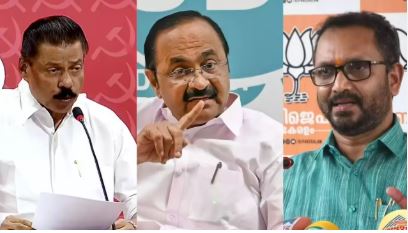
The recent uproar began when Congress leader and opposition head V.D. Satheesan expressed preparedness to accept support from Jamaat-e-Islami, stating that the organization does not advocate for a religion-based nation in India. This comment prompted swift backlash from both the CPM and the BJP, who argued that Congress was legitimizing what they termed communal elements.
BJP’s senior leader K. Surendran criticized Congress for its perceived closeness to Jamaat-e-Islami, alleging that if the UDF were to gain power, it would lead to the imposition of “sharia” in Kerala. Surendran denounced Congress’s stance as a blatant endorsement of communal forces, accused it of “whitewashing” extremist groups, and questioned the integrity of their political objectives.
CPM’s Accusations of Hypocrisy
In response, the CPM intensified its criticism. State Secretary M.V. Govindan claimed that Congress’s comments amounted to portraying Jamaat-e-Islami as a non-communal entity, asserting that they were attempting to grant legitimacy to the organization.
V.D. Satheesan countered these claims, labeling them as hypocritical. He pointed out that the CPM had benefitted from Jamaat-e-Islami’s support in the past, asserting that notable figures within the Marxist party had received electoral backing from the organization. He emphasized that over the years, CPM had altered its stance to appease varying community interests, leading to a lack of clarity in their current position.
Understanding Jamaat-e-Islami’s Role
Jamaat-e-Islami Hind, the Indian branch situated in Kerala, is recognized for its socio-religious initiatives including educational institutions and social programs. Although it does not wield dominant electoral influence, the organization’s backing can hold weight in specific districts, particularly in the northern regions where margins of victory are typically narrow.
Controversy has frequently surrounded the group due to its conservative views. Recent statements by its leader, Shaikh Muhammed Karakunnu, have reiterated that a true belief in the teachings of Prophet Muhammad aligns with the notion of an Islamic Republic, creating renewed scrutiny from opposing political entities.
A Shifting Political Landscape
Kerala’s traditional political framework has been predominantly bipolar, characterized by contests between the CPM-led Left Democratic Front (LDF) and the Congress-led United Democratic Front (UDF). Meanwhile, the BJP has struggled to translate its increased vote share into tangible electoral gains. Discussions around minority outreach and ideological commitments play significant roles within this competitive environment.
For the CPM, taking a stand against Congress regarding Jamaat-e-Islami allows it to challenge the UDF’s secular stance while aiming to strengthen its base among various voter demographics. Concurrently, the BJP leverages this issue to portray both the Left and Congress as engaging in minority appeasement, aligning with its broader narrative within Kerala.
The Congress, on its part, seeks to reassure minority voters of its openness to diverse support while defending against accusations of promoting communal politics. In this context, the discussions about Jamaat-e-Islami reflect deeper ideological divisions and the negotiations surrounding minority support within the state’s political fabric.
The Broader Implications
With Kerala’s substantial Muslim population, the consolidation of minority votes can greatly influence electoral results in many constituencies. Historically, the Indian Union Muslim League has been the leading voice for Muslim interests within the UDF. However, organizations like Jamaat-e-Islami add complexity to the political dynamics at play.
The CPM has previously engaged with community associations, citing such interactions as essential to Kerala’s pluralistic political reality. The Congress argues that its involvement should likewise not be mischaracterized as communal. The BJP’s focus on framing this issue from a national perspective aims to solidify its position as a staunch advocate of secular governance amidst rising tensions in the political arena.
This ongoing debate intersects with various outreach initiatives by each party, as the UDF and LDF both employ elements of the Jamaat-e-Islami controversy to reshape their campaign narratives, revealing the intricate interplay of community relations and secular politics in Kerala