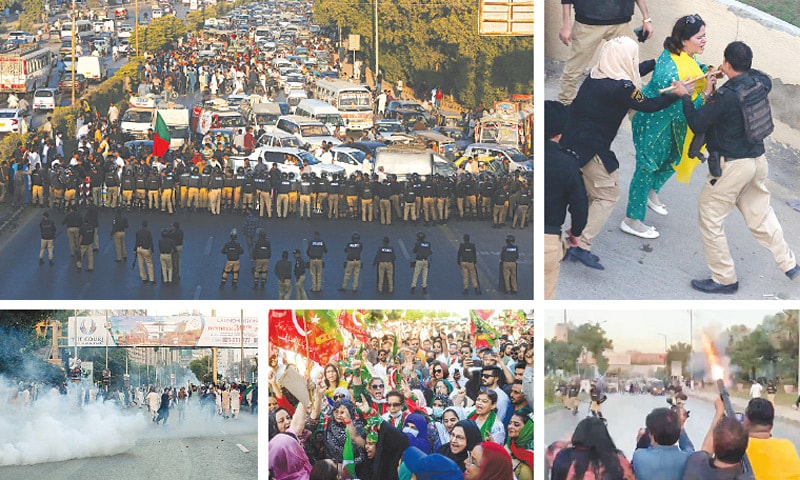
On Saturday, police employed tear gas and baton charges to disperse Jamaat-e-Islami (JI) activists who attempted to march toward the Sindh Assembly. The protest aimed to draw attention to the deteriorating civic conditions in Karachi and to call for reforms in the local government system. Under the slogan “Jeenay Do Karachi Ko” (Let Karachi Live), the party initiated this demonstration, seeking immediate government action regarding the city’s infrastructure, notably its damaged roads, drainage issues, and declining civic services.
Confrontation Erupts as Protesters Attempt to Reach Restricted Area
The situation escalated when JI supporters tried to breach police barricades that had been established along the routes leading to the Sindh Assembly. In response to the advancing crowd, law enforcement resorted to firing tear gas and utilizing batons to prevent the protesters from entering the designated Red Zone. This confrontation resulted in injuries to at least one JI member and also reportedly left several police officers hurt after some demonstrators allegedly engaged in stone-pelting.
Detentions and Equipment Confiscation Amid Protest
During the crackdown, authorities confiscated a sound system that had been set up on a truck included in the rally and detained a minimum of ten JI activists. Despite the significant police presence, a number of protesters were able to bypass the barricades and reach the vicinity of the Sindh Assembly. This created a tense atmosphere in the surrounding area, prompting the deployment of a large police force to deter further escalation and block additional protesters from advancing.
Government Officials Respond to Protest Dynamics
Sindh Information Minister Sharjeel Inam Memon stated that there had been ongoing communication between the police and JI leadership, stressing that they had advised the party to maintain a peaceful protest while cautioning against entering prohibited zones. Memon added that some JI supporters attempted to forcibly access the assembly area and engaged in stone-throwing, leading authorities to respond with forceful measures including tear gas and arrests. He affirmed that law enforcement would not allow disorder.
Jamaat-e-Islami Officials Criticize Police Actions
In response to the government’s assertions, JI Karachi chief Munim Zafar refuted the claims and expressed condemnation of the police’s tactics. He emphasized that the protest was designed to advocate for the basic rights of Karachi residents, particularly their access to water and key services. Zafar described the police’s reliance on tear gas and violence as “unacceptable.” A JI spokesperson noted that barriers had been placed along the routes to the Sindh Assembly, which forced demonstrators to conduct a sit-in on an alternative road.
Ongoing Protests Planned Across Karachi
Further, it was reported that party leaders, including Muslim Parvez, Abdul Razzaq, and Sindh Assembly member Muhammad Farooq, sought to engage in dialogue but found no administrative representatives present at the scene. MPA Farooq stated to the media that the protest would persist on the side of the road. Following the events, Munim Zafar declared that Jamaat-e-Islami would conduct protests at ten locations throughout Karachi the following day to oppose the use of force against their sit-in outside the Sindh Assembly.