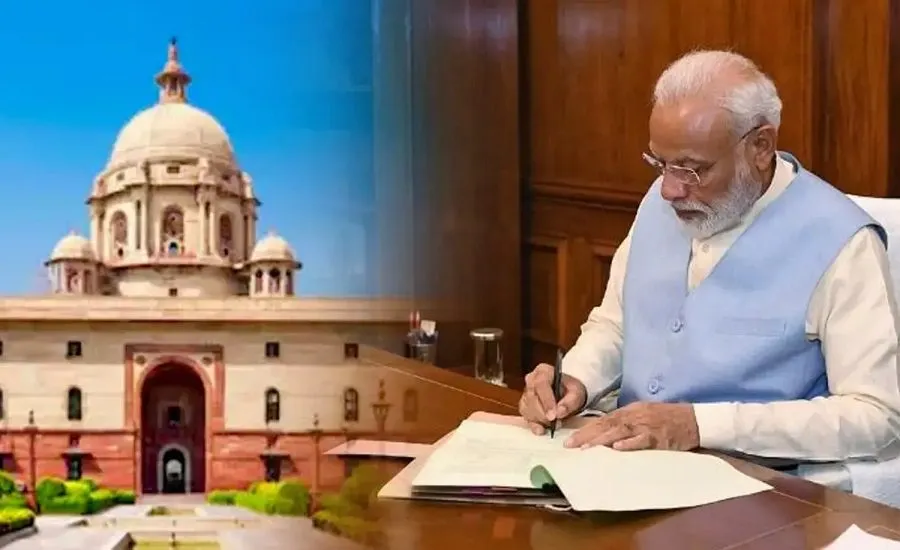
New Delhi: The Prime Minister’s Office (PMO) will officially relocate from the South Block, a government cornerstone for more than fifty years, to the newly constructed Seva Teerth on Friday afternoon. Before this transition, Prime Minister Narendra Modi is scheduled to preside over his final Cabinet meeting in South Block. The new PMO is situated less than one kilometer from the iconic South Block building on Raisina Hill.
Transition Ceremony and Structural Changes
Following the Cabinet meeting, Union ministers and bureaucrats are set to proceed from South Block to Seva Teerth, which will serve as the new hub for the PMO, the Cabinet Secretariat, the National Security Advisor’s office, and India House, which will accommodate high-level delegations. This move marks a significant milestone in the PMO’s history, which dates back to its origins as a small secretariat established in 1947.
Historical Context of the Prime Minister’s Office
The South Block, alongside the North Block, was constructed in 1931 and has been a witness to pivotal moments in Indian governance. The first Cabinet meeting held in South Block dates back to Jawaharlal Nehru’s administration. A critical evolution came in 1964 when the PM’s Secretariat was granted statutory status under the Allocation of Business Rules, enhancing the office’s authority, especially during the tenure of Indira Gandhi.
In 1977, during Morarji Desai’s government, the PM’s Secretariat was officially renamed the Prime Minister’s Office, reflecting its expanded role in Indian administration. The impending move to Seva Teerth signifies not only a change of location but also aligns with the ongoing restructuring efforts within the Indian administrative framework.
Future Developments Following the Shift
Over the coming weeks, additional changes are expected as the Ministries of Defence and External Affairs will also be relocating from South Block to various offices. This is part of a broader initiative aimed at modernizing the administrative landscape, making it more efficient and accessible.
As this transition occurs, the historical significance of South Block will remain a part of India’s political narrative. The move to Seva Teerth is viewed as a step towards modern governance while honoring the legacy and evolution of the PMO.