


app-store-logo
play-store-logo
March 13, 2026

Over 660 Crore Court Pages Digitised; 2,444 eSewa Kendras Established Under e-Courts Initiative
The CSR Journal Magazine

The Indian Government has implemented various initiatives aimed at bolstering the digital framework of the judiciary. These efforts are primarily designed to expedite case processing, augment transparency, and enhance access to justice. The measures are predominantly being executed under the e-Courts Mission Mode Project and a centrally sponsored scheme that aids State Governments and Union Territories in establishing infrastructure for district and subordinate courts.

Phased Approach to Digital Transformation

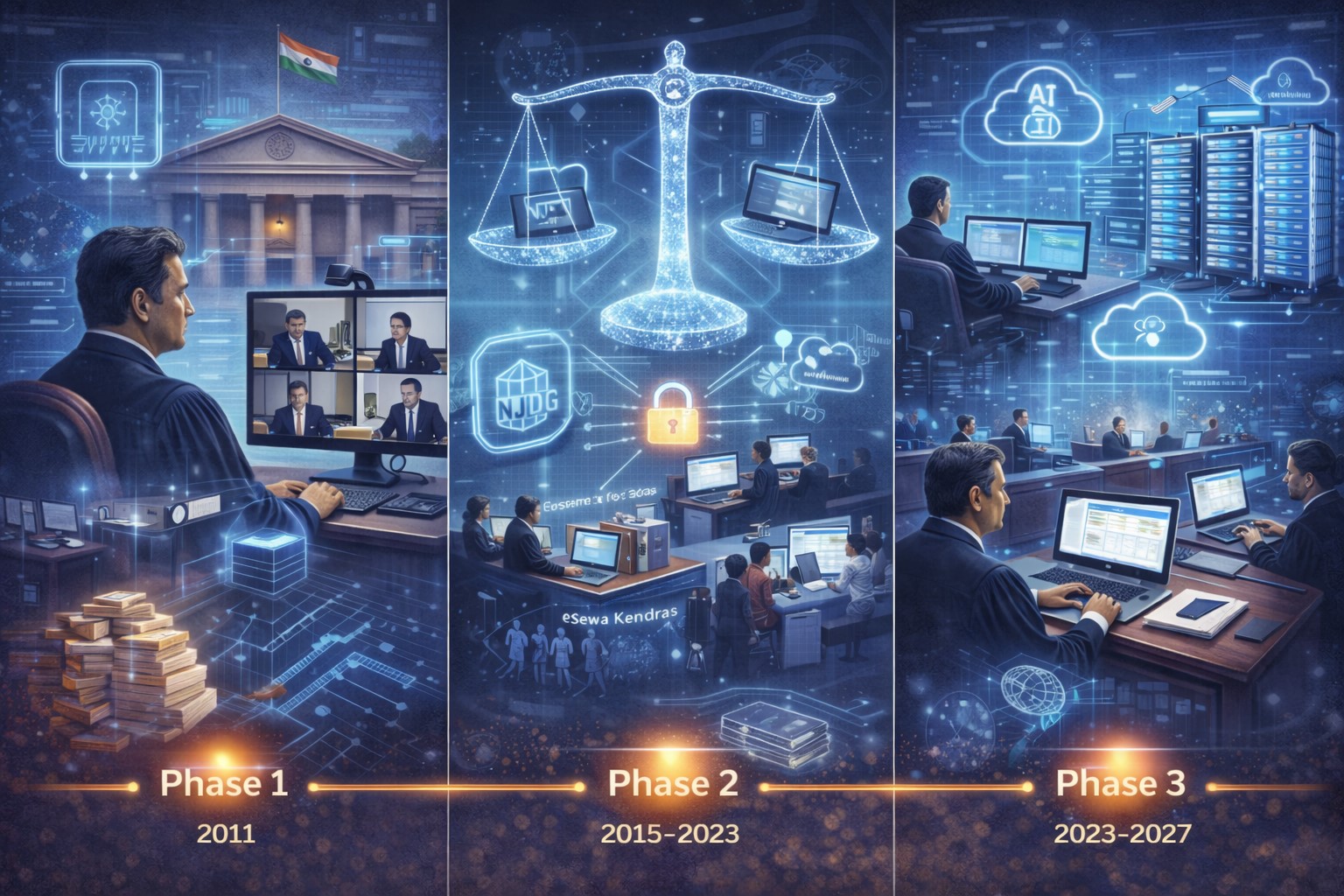
In a recent update provided by Minister of State for Law and Justice, Arjun Ram Meghwal, during a session in the Rajya Sabha, it was highlighted that the digital justice system incorporated under the e-Courts project has substantially streamlined judicial processes. The initiative also aims to foster a transparent and accessible justice delivery system. The project commenced its first phase in 2011 with a budgetary allocation of Rs. 935 crore, concentrating on laying down the foundational digital infrastructure across the nation’s courts. This phase witnessed the computerisation of 14,249 district and subordinate courts, installation of Local Area Networks in 13,683 courts, and the activation of digital case management software in 13,672 courts. Additionally, video conferencing facilities were introduced in 493 courts and 347 jails.

Expansion and Citizen-Centric Services

The second phase, spanning from 2015 to 2023 with an estimated budget of Rs. 1,670 crore, shifted its focus toward citizen-centric digital services. The number of computerised courts rose to 18,735, indicating a 31.5 per cent increase compared to the first phase. Video conferencing facilities were significantly expanded, impacting 3,240 courts and 1,272 jails while nearly 99.5 per cent of court complexes were linked via Wide Area Network (WAN) for stable digital connectivity. This phase also introduced crucial digital platforms, such as the Case Information System (CIS), National Judicial Data Grid (NJDG), and eSewa Kendras, which assist citizens and legal professionals with court-related services.

Future Plans and Budgetary Provisions

For the third phase of the e-Courts initiative, the government has allocated a substantial budget of Rs. 7,210 crore for the period between 2023 and 2027. This phase aims to convert Indian courts into fully digital and paperless entities. Key objectives include the digitisation of legacy and ongoing case records, the extension of video conferencing facilities to courts, jails, and hospitals, and broadening the scope of online courts beyond traffic cases. Furthermore, it envisions the establishment of eSewa Kendras nationwide and a cloud-based data repository for secure storage of digitised court records and applications.

Current Achievements in Digital Courts

As of now, more than 660.36 crore pages of court documents have been digitised, and a total of 2,444 eSewa Kendras have been set up across the country to enhance citizen service delivery. Over 3.97 crore hearings have been conducted via video conferencing, and approximately 1.07 crore cases have been filed electronically through the eFiling platform. The government has also expanded live streaming of court proceedings to additional High Courts, including those in Uttarakhand, Calcutta, Telangana, and Meghalaya, bringing the total to eleven High Courts offering this facility.

Digital Innovations and Workflow Integration

All eCourts portals are now hosted on the National Informatics Centre’s cloud infrastructure, and the websites of district courts have transitioned to the Secure, Scalable, and Sugamya Website as a Service (S3WAAS) platform. The Case Information System has been upgraded to CIS 4.0 to enhance transparency, objectivity, and efficiency in case management. Innovative technologies, including Artificial Intelligence and Optical Character Recognition, are being integrated into judicial workflows. These advancements feature an AI-based defect identification module developed in collaboration with IIT Madras and the Legal Research and Analysis Assistant (LegRAA) from the NIC’s Centre of Excellence.

Judicial Accessibility and Paperless Goals

Officials noted that the Digital Courts platform currently enables judges to access all case-related documents, pleadings, and evidence online, representing a significant stride towards achieving a fully paperless judicial ecosystem in India.

Long or Short, get news the way you like. No ads. No redirections. Download Newspin and Stay Alert, The CSR Journal Mobile app, for fast, crisp, clean updates!

App Store –  https://apps.apple.com/in/app/newspin/id6746449540 

Google Play Store – https://play.google.com/store/apps/details?id=com.inventifweb.newspin&pcampaignid=web_share

Latest News

Popular Videos
