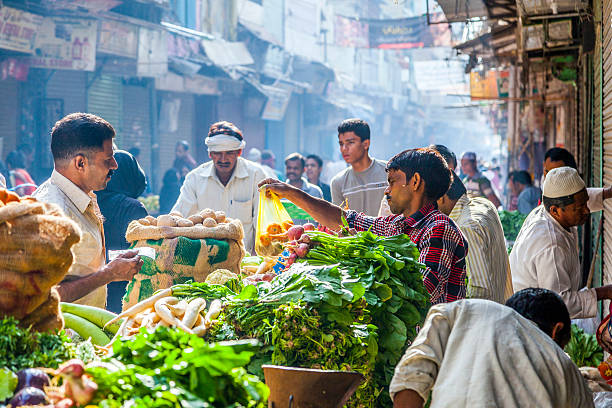
Delhi, India - October 16, 2012: Cman sells vegetables at Chawri Bazaar. Chawri Bazar is a specialized wholesale market of food and vegetables in Delhi, India. Established in 1840 it was the first wholesale market of Old Delhi.
Pakistan’s supply chain for fruits and vegetables remains largely dominated by outdated market frameworks, stifling the potential for modern technology solutions. While many global sectors have witnessed significant transformations due to tech-driven entities, the agricultural marketing landscape in Pakistan is still heavily influenced by traditional middlemen and stringent regulations. Recent observations indicate that while digital marketplaces and rapid delivery services are gaining traction in urban areas, their impact on the fresh produce market is minimal.
A substantial portion of fruits and vegetables continues to pass through conventional wholesale markets, where commission agents effectively dictate trading volumes and prices. Representatives from farming communities have expressed concerns that online trading platforms make up only a small fraction of the overall fruit and vegetable commerce within the country. Mahmood Nawaz Shah, the President of the Sindh Abadgar Board, remarked that these digital avenues currently account for merely two to three percent of the agricultural supply chain in Pakistan.
Regulatory Framework Limits Market Dynamics
The existing regulatory environment presents significant challenges to technological advancements in the agricultural sector. As outlined by provincial statutes known as the Market Produce Act, trading of fruits and vegetables is mandated to occur within officially recognized wholesale markets. These designated areas operate under government-appointed committees that centralize large-scale trading in specific locales, thereby perpetuating the traditional mandi system.
Within this framework, commission agents assume a prevalent role, often providing farmers with pre-production credit in exchange for a commitment to sell their crops through these intermediaries. This dependency creates a cycle that restricts farmers’ bargaining power and binds them to the same agents over successive harvests. Such arrangements inhibit the introduction of more competitive practices that could benefit agricultural producers.
Infrastructure Challenges Compound Issues
Infrastructure limitations further entrench the traditional mandi system. Karachi, with a population surpassing 20 million, relies predominantly on a single wholesale market for fruits and vegetables that spans approximately 100 acres. Farmer associations contend that this limited infrastructure consolidates trading power and diminishes competitive opportunities within the supply chain, leading to inefficiencies.
While advocates of technological innovation assert that systems for digital procurement, enhanced cold-chain logistics, and direct sourcing could streamline operations and minimize waste, experts point out that substantial changes in the sector would necessitate significant regulatory alterations. Additionally, there is a clear need for increased investment in agricultural logistics to enable a shift towards more modern practices.
Long or Short, get news the way you like. No ads. No redirections. Download Newspin and Stay Alert, The CSR Journal Mobile app, for fast, crisp, clean updates!
Pakistan's Army has successfully conducted a test launch of the Fatah-II Extended Range hypersonic ballistic missile. This advanced weapon system is equipped with sophisticated...