


app-store-logo
play-store-logo
March 17, 2026

NASA’s Parker Solar Probe Completes 27th Close Approach to the Sun, Gathers Crucial Solar Data
The CSR Journal Magazine

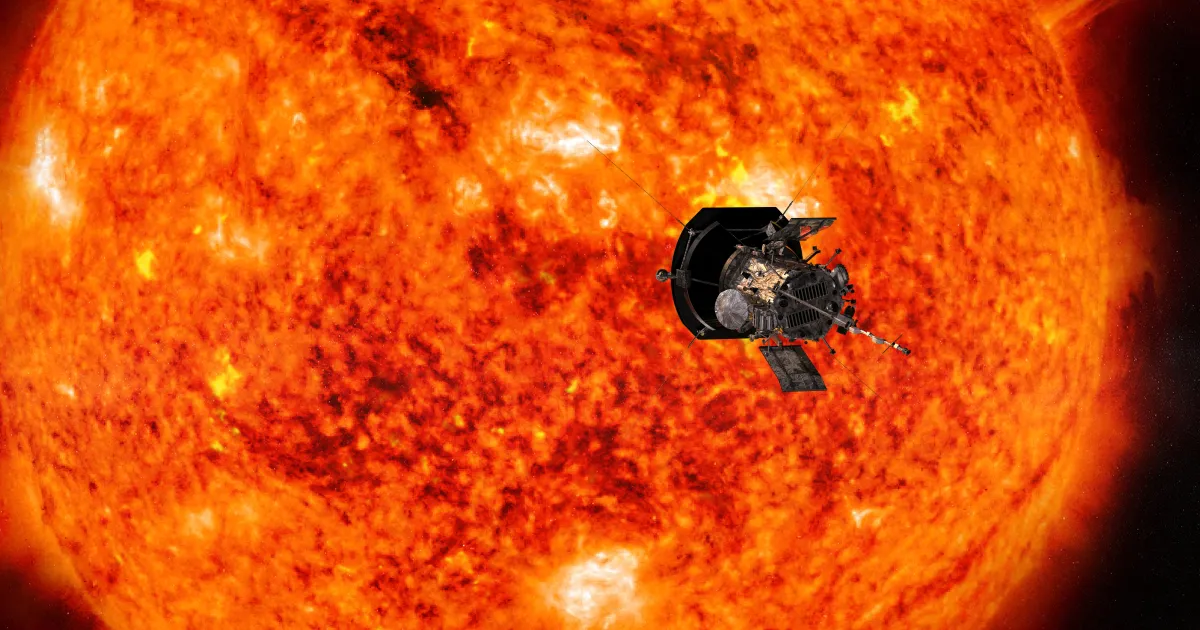
The Parker Solar Probe, developed by NASA, made headlines once again on March 11, 2026, by successfully completing its 27th close approach to the Sun. During this flyby, the spacecraft traversed within approximately 6.2 million kilometres from the solar surface.

While this distance may seem vast, it is relatively close in the context of space exploration, especially considering Earth is situated about 150 million kilometres from the Sun. The Parker probe, which is the size of a car, has been on a mission since its launch in August 2018, aimed at studying the Sun more closely than any previous spacecraft.

Mission Objectives and Achievements

The primary objectives of the Parker Solar Probe are to investigate the Sun’s outer atmosphere and understand the origins of solar wind, which is a continuous flow of charged particles emanating from the Sun. This research aims to enhance scientific predictions regarding space weather events that can have significant consequences for life on Earth.

During its latest flyby, the probe effectively collected data on solar wind and monitored solar activity, enabling scientists to gain new insights into the Sun’s behavior over time.

Autonomous Operation During the Flyby

In the month leading up to and during its closest approach, the Parker Solar Probe operated autonomously. Due to its close orbit around the Sun, the spacecraft was unable to communicate with mission control on Earth. It successfully resumed contact on March 14, sending a confirmation signal to the flight controllers at the Johns Hopkins Applied Physics Laboratory in Maryland, indicating that all systems were functioning normally.

The solar encounter spanned from March 6 through March 16, during which Parker’s four scientific instruments gathered crucial data from the Sun’s corona, the outermost layer of its atmosphere.

Significance of the Research

This mission serves more than just a scientific curiosity; it plays a vital role in comprehending space weather. Parker’s observations of significant solar phenomena, such as coronal mass ejections and solar flares, are essential for understanding the dynamics of space weather, which poses risks to astronauts, could disrupt satellites, affect air travel, and potentially impact power grids on Earth.

Since its launch when the Sun was relatively calm, Parker has observed the star entering an active phase known as solar maximum, providing researchers with a unique vantage point to watch these fluctuations in solar activity.

Future Data Transmission

The scientific data collected during this recent solar encounter is anticipated to start transmitting back to Earth on March 18. This information is expected to provide vital insights that contribute to the ongoing research on solar phenomena, thus further enriching our understanding of solar dynamics and their implications for both space exploration and life on our planet.

Long or Short, get news the way you like. No ads. No redirections. Download Newspin and Stay Alert, The CSR Journal Mobile app, for fast, crisp, clean updates!

App Store –  https://apps.apple.com/in/app/newspin/id6746449540 

Google Play Store – https://play.google.com/store/apps/details?id=com.inventifweb.newspin&pcampaignid=web_share

Latest News

Popular Videos
