


NASA to Develop Moonfall Drones for Lunar Exploration
The CSR Journal Magazine

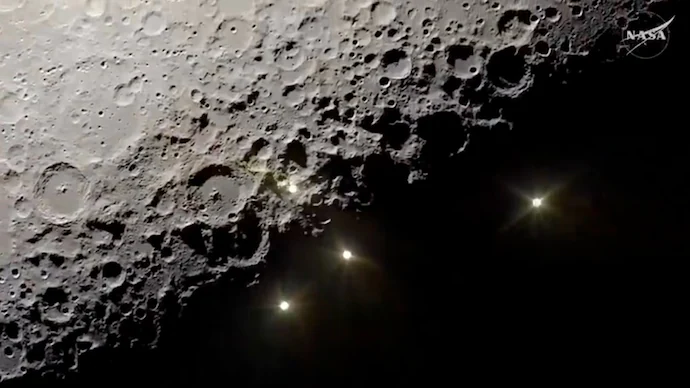
NASA is advancing a new initiative to deploy autonomous drones on the Moon, intended to significantly enhance the exploration of its rugged and remote landscapes. This project, known as Moonfall Drones, is particularly focused on site surveillance and terrain mapping around the lunar South Pole, a region recognized for its scientific importance yet challenging nature. The Moonfall Drones will be an integral part of the broader Artemis mission, which aims to establish a sustained human presence on the Moon and support the planned lunar base.

Understanding the Flight Mechanism on an Airless Moon

Details from the Moonfall Drones concept reveal that these drones are set to operate under a single launch architecture and function independently upon landing on the lunar surface. Unlike traditional Earth-based drones that rely on air for lift, these lunar devices will employ propulsion-based hopping mechanisms powered by onboard engines. Each drone is engineered to execute multiple controlled hops, covering a maximum total distance of 50 kilometers. This system offers rapid mobility with a launch-to-landing cycle of approximately 150 seconds and reaching altitudes of around 1 kilometer during each hop. This novel approach facilitates movement across craters, rocky terrains, and regions shrouded in eternal shadows that are challenging for conventional rovers to navigate.

The Challenge of Operating in a Vacuum

The Moon’s lack of atmosphere makes traditional flight unfeasible, as there is no air available to generate lift. NASA’s innovative approach overcomes this limitation with rocket-like propulsion systems. The drones are outfitted with main engines, fuel reservoirs, and attitude control systems to ensure stable and directed movement. By activating their engines, the drones can take off, traverse short distances, and land accurately at new sites, akin to miniature reusable landers.

Advanced Technology and Payload Capabilities

NASA has incorporated several state-of-the-art systems into the drones, including solar panels for energy generation, battery packs for storing power, and avionics for navigation and control. Additionally, these drones are equipped with ground-penetrating radar (GPR) for subsurface analysis. The drones are capable of carrying multiple payloads, such as optical cameras which allow for high-resolution imaging of the lunar surface.

Enhancing Performance During Lunar Nights

A significant design consideration is enabling the drones to survive the extremely cold lunar nights, during which temperatures can drop drastically. These drones are expected to feature advanced avionics designed to withstand such harsh conditions. If successful, the Moonfall Drones could greatly improve lunar exploration by facilitating faster and more adaptable coverage than traditional rovers provide. The technology may also play a vital role in future missions, including the mapping of resources and selecting sites for sustained human activities on the Moon.

Future Implications for Lunar Exploration

As NASA prepares for extended lunar missions, these innovative mobility solutions have the potential to reshape the methods by which humanity studies and may ultimately inhabit the Moon. The introduction of Moonfall Drones marks a significant step forward in the pursuit of understanding our nearest celestial body, opening new avenues for research and exploration in this unexplored frontier.

Long or Short, get news the way you like. No ads. No redirections. Download Newspin and Stay Alert, The CSR Journal Mobile app, for fast, crisp, clean updates!

App Store –  https://apps.apple.com/in/app/newspin/id6746449540 

Google Play Store – https://play.google.com/store/apps/details?id=com.inventifweb.newspin&pcampaignid=web_share

Latest News

Popular Videos
