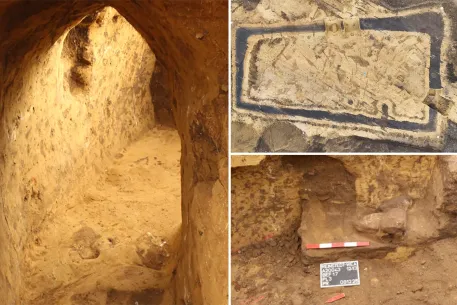
Archaeologists in Germany have made a remarkable discovery involving a medieval tunnel system located beneath a Neolithic burial site. This finding, revealed in a press release from the State Office for Heritage Management and Archaeology of Saxony-Anhalt, has sparked significant interest and numerous questions regarding the interplay between different historical eras within the same geographical area. The excavations took place near Reinstedt and were necessitated by plans for wind turbine construction.
Details of the Burial Site
The burial site that has garnered attention is associated with the Baalberge culture, which thrived approximately 5,000 years ago during the Middle Neolithic period. At this site, archaeologists found a large ditch enclosure alongside several burials, which have been poorly preserved. These were historically used for funerary and ritualistic practices. Initial excavation efforts focused on what was believed to be a grave when a trapezoidal pit and a stone slab were discovered.
Discovery of the Tunnel System
Further digging revealed that the trapezoidal pit extended downwards into the loess subsoil, ultimately leading to the identification of an erdstall. This narrow tunnel system is typically dated to the late Middle Ages and is predominantly found throughout Central Europe. The function and purpose of these tunnels have been subjects of scholarly debate for years, with many interpretations lacking definitive evidence.
Contents Found Within the Tunnel
Inside the tunnel, archaeologists uncovered various artifacts, including late medieval pottery, an iron horseshoe, remnants of animal bones, several stones, and traces of charcoal, indicative of a brief fire. At the entrance, larger stones arranged together suggested that the tunnel may have been sealed intentionally. These findings confirmed that the structure was not only human-made but also utilized for a certain period before being deliberately closed off.
Significance of the Location
The most intriguing aspect of this discovery is the positioning of the medieval tunnel directly beneath the ancient burial site. Archaeologists propose that this correlation was likely intentional rather than coincidental. One theory posits that medieval inhabitants had visibility of the prehistoric structures and used them as reference points while constructing the tunnels. An alternative perspective suggests that the medieval Christian community may have refrained from disturbing the pagan burial grounds, perceiving them as appropriate sites for discreet developments.
Theories Surrounding the Function of Erdstalls
The exact purpose of erdstalls continues to elude definitive conclusions among historians. Some scholars have suggested that these spaces may have functioned as temporary hideouts, storage facilities, or even venues for ritualistic and cultic practices. The limited dimensions of the tunnel at Reinstedt, along with the sparse evidence of long-term habitation, lend support to the theory that it was used sporadically rather than being a site of permanent residence.