


A Meteorite Crater Confirmed By Drilling In Western Australia
The CSR Journal Magazine

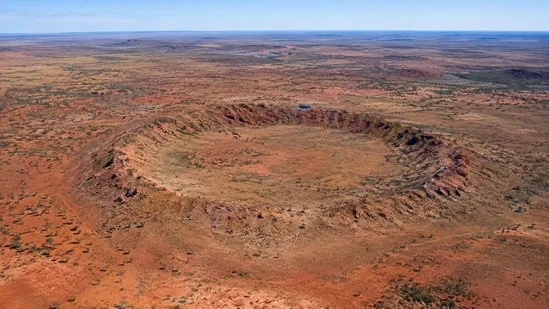
The Hickman Crater, a circular formation in a remote region of Western Australia, was identified as a meteorite impact site. This discovery was made by geologist Arthur Hickman while he was exploring satellite images on Google Earth in 2007, specifically looking for channel iron formations. The crater, measuring 260 metres in diameter, has since been named after Hickman.

The initial scientific description of the crater was published in the Australian Journal of Earth Sciences in 2008, co-authored by Andrew Glikson, Arthur Hickman, and John Vickers. The morphology of the crater appeared consistent with small-scale impact craters, although the first study did not find any chemical evidence of an extraterrestrial source in the samples that were analysed.

Geological Features Of The Crater

The Hickman Crater is situated at the junction of the Woongarra Rhyolite and the overlying Boolgeeda Iron Formation. The rim of the crater rises up to 30 metres above the flat bottom, indicating significant geological activity. The presence of fragmented rocks, breccia, and goethite veins around the structure suggests that the area experienced intense disturbances and heating.

Despite these geological features, the 2008 study did not find anomalies of nickel or platinum group elements in the two goethite veins tested. The researchers concluded that the iron-altered rocks were indicative of a hydrothermal environment involving heated groundwater. Nevertheless, they maintained that the crater likely had an impact origin, estimating its original depth at 80 metres, formed by a meteorite approximately 10 metres wide. The crater’s age was dated to the Late Pleistocene epoch, between 10,000 and 100,000 years ago.

In a 2015 interview with Australian Geographic, Hickman recounted how he first noticed the circular formation while examining Google Earth images. Upon confirming that it was a genuine geological feature, he contacted Andrew Glikson, an expert in impact structures, who visited the site in August 2007. The Western Australian Museum Field Guide to Impact Craters, published in 2012, highlighted an expedition to significant impact sites in the area, noting that definitive evidence of the Hickman Crater’s impact origin remained buried beneath the surface.

Drilling Investigations And Findings

In late 2012, a drilling investigation was conducted by the Geological Survey of Western Australia in collaboration with Atlas Iron Ltd. A vertical borehole was drilled to a depth of 64.7 metres at the centre of the crater. According to a report by Peter Haines published in 2014, the drilling revealed a sequence of crater fill sediments, breccia, and fractured bedrock.

Significantly, a layer found between depths of 48.4 and 55.1 metres contained angular rock blocks associated with fragments of glassy melt rock, identified as suevite, a type of impact breccia. Beneath this layer was the highly fractured Woongarra Rhyolite, believed to be the crater’s bedrock. Chemical analyses of six samples from the melt breccia showed elevated concentrations of nickel, cobalt, gold, and platinum group elements compared to surrounding rocks.

Nickel levels ranged from 295 to 2,381 parts per million, while iridium levels varied from 9 to 85 parts per billion. The abundance of platinum group elements was found to be more consistent with meteorites than with typical continental crust. However, some expected signs, such as planar deformation features indicative of shock metamorphism, were not observed, possibly due to atmospheric drag reducing the object’s speed and impact pressure.

Changes following the impact were also noted in the core. Sediments were deposited within the crater, and a stream breached the northern rim, further contributing to sediment accumulation in what may have been an isolated crater lake. The identification of Hickman Crater involved multiple stages, including satellite imaging, fieldwork, geological analysis, and drilling through the impact layer, beginning with the crater’s 260-metre outline and culminating in chemical evidence that confirmed its identity.

Long or Short, get news the way you like. No ads. No redirections. Download Newspin and Stay Alert, The CSR Journal Mobile app, for fast, crisp, clean updates!

App Store – https://apps.apple.com/in/app/newspin/id6746449540

Google Play Store – https://play.google.com/store/apps/details?id=com.inventifweb.newspin&pcampaignid=web_share

Latest News

Popular Videos
