


app-store-logo
play-store-logo
December 8, 2025

Mahmud of Ghazni’s Massacres and Temple Destruction Now Added to Class 7 NCERT Textbook
The CSR Journal Magazine

NCERT’s newly released Class 7 Social Science textbook introduces a significantly expanded account of Mahmud of Ghazni’s invasions, shifting from the earlier single-paragraph mention to a detailed six-page narrative. Released on Friday, the updated book aims to give students a clearer and more contextual understanding of one of the subcontinent’s most violent historical phases, supported by illustrations, historical extracts, and guided questions.

A Broader View of a Violent Era

The revised section, titled “The Ghaznavid Invasions,” delves into Mahmud’s military expeditions across cities such as Mathura, Kannauj, and Somnath. The text explains that historical writing often records conflict more vividly than peace or cultural achievements, and reminds readers that while the past cannot be altered, learning about it helps societies understand causes and consequences, without holding present-day people responsible for centuries-old actions.

Graphic Accounts of Plunder and Religious Motivations

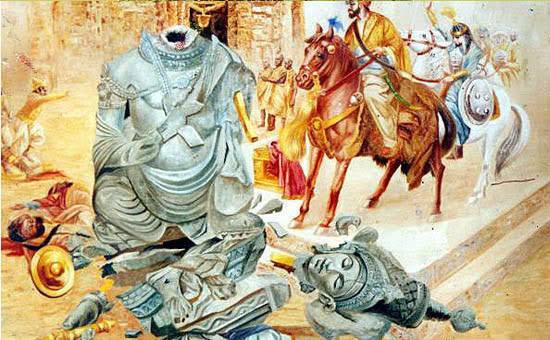
The new content describes Mahmud as a formidable yet ruthless commander whose campaigns resulted in widespread suffering. According to the textbook, his raids led to the deaths of tens of thousands of civilians and the enslavement of many others, including children who were transported to Central Asian slave markets. The destruction of temples, shrines, and sacred structures features prominently, with Mahmud portrayed as targeting not only Hindus, Buddhists, and Jains but also rival Islamic sects.

“Although he faced strong resistance–particularly from the Chandellas of central India–and narrowly escaped defeat on several occasions, his large army’s rapid marches and daring cavalry attacks, supported by mounted archers, ultimately proved decisive,” the section reads.

“Mahmud’s campaigns involved not only destruction and plunder but also the slaughter of tens of thousands of Indian civilians and the capture of numerous prisoners, including children, who were taken to be sold in the slave markets of Central Asia,” the book states.

Citing contemporary chroniclers such as Al-Utbi, the book recounts how temples were demolished, livestock and valuables seized, and mosques erected to mark the dominance of Ghaznavid rule. Al-Biruni’s observation about the destruction of the Somnath Shivalinga and the transfer of its fragments to Ghazni is also included.

“Mahmud destroyed the temple and seized its treasure before proceeding to Kannauj, where he surprised one of the last Pratihara rulers and looted and destroyed several temples. A few years later, another campaign took him to Gujarat and the seaport of Somnath (in present-day Saurashtra). Despite strong local resistance and heavy losses to his forces, Mahmud eventually prevailed after several days of fighting, destroyed the Somnath Shiva temple, and carried away its vast treasures,” the book added.

“Mahmud utterly ruined the prosperity of the country and performed there, Centuries of wonderful feats, by which the Hindus became like atoms of dust. Scattered in all directions,” the book quotes Al-Biruni.

The book further notes that the reconstruction of the Somnath temple in 1950, funded through public donations and inaugurated by President Rajendra Prasad, invites reflection on the significance of historical memory.

Integrating Mahmud Within Larger Historical Developments

The chapter “Turning Tides: 11th and 12th Centuries” extends beyond Mahmud to discuss the rise of subsequent Turkic invaders. It highlights Muhammad Ghuri, his general Qutb-ud-din Aibak, and commander Bakhtiyar Khilji, who led devastating assaults in eastern India. Khilji’s destruction of the renowned Buddhist centres of Nalanda and Vikramashila and its role in the decline of Buddhism in India receives detailed attention, material missing from previous Class 7 editions.

The chapter emphasizes that despite these invasions, large regions of southern and northern India remained beyond Turkic control, with local rulers occasionally forming alliances to resist external aggression.

Placed Within a Wider Historical Timeline

To give students a fuller picture, the textbook portrays these invasions within a long arc of political change beginning in the 6th century. It outlines the rise and decline of the Chalukyas, Rashtrakutas, Pallavas, Cholas, as well as rulers of Kannauj and Kashmir. It also covers earlier foreign incursions like those of the Hunas and the Arab expedition led by Muhammad bin Qasim, noting the limited and largely regional impact of Qasim’s conquest in Sindh.

Aligned With NEP 2020 and New Curriculum Structure

The expanded content is part of NCERT’s ongoing effort to update textbooks under the National Education Policy (NEP) 2020 and the National Curriculum Framework 2023. As part of this overhaul, Class 7 students will now use two integrated textbooks combining history, civics, and geography, replacing the older three-book format.

NCERT Director Dinesh Saklani stated that the revised material is meant to offer a balanced and comprehensive view of India’s past, enabling students to engage critically with historical developments.

Who was Mahmud of Ghazni?

Mahmud of Ghazni was a Turkic ruler (971-1030 AD) famous for his 17 invasions of India (1000-1027 AD), driven mainly by plundering immense wealth from rich temples and cities, like the famed Somnath Temple in 1025, to fund his empire, establishing his reputation as a “Butshikan” (idol-breaker) and opening India to later Islamic invasions.

His campaigns targeted areas like Punjab, Multan, Mathura, and Kanauj, defeating rulers like Jayapal and Anandpal, and leaving a legacy of destruction and fear, but also paving the way for future Islamic rule in India, note Vajiram & Ravi.

Long or Short, get news the way you like. No ads. No redirections. Download Newspin and Stay Alert, The CSR Journal Mobile app, for fast, crisp, clean upda

App Store – https://apps.apple.com/in/app/newspin/id6746449540

Google Play Store – https://play.google.com/store/apps/details?id=com.inventifweb.newspin&pcampaignid=web_share

Latest News

Popular Videos
