


app-store-logo
play-store-logo
February 24, 2026

L&T Secures Contract to Construct India’s LIGO Detector in Maharashtra
The CSR Journal Magazine

Engineering firm Larsen & Toubro (L&T) has been awarded a significant contract to develop India’s LIGO observatory, an ambitious scientific initiative aimed at detecting gravitational waves generated by major cosmic phenomena such as black hole mergers and neutron star collisions. This contract has been granted by the Department of Atomic Energy (DAE). The observatory is set to be established in Aundha, located in Maharashtra’s Hingoli district, and is expected to be completed within a four-year timeframe. Two divisions of L&T, namely Heavy Civil Infrastructure (HCI) and Heavy Engineering (HE), are set to collaborate on the execution of this project. Their responsibilities will encompass the engineering, procurement, and construction of specialized civil infrastructure that is critical for the observatory’s precise measurements.

What is LIGO?

The Laser Interferometer Gravitational-Wave Observatory, commonly referred to as LIGO, is an advanced scientific instrument engineered to detect gravitational waves, which are small distortions in the fabric of space-time first theorized by Albert Einstein more than a hundred years ago. These gravitational waves are produced by cataclysmic cosmic events such as the collision of black holes or supernovae that occur billions of light-years away. To capture these faint signals, LIGO utilizes an intricate system of lengthy tunnels outfitted with laser interferometers. Laser beams are transmitted through long vacuum tubes and reflected back. Even minute disturbances, smaller than the width of a proton, can signal the arrival of a gravitational wave.

Specifications of LIGO India

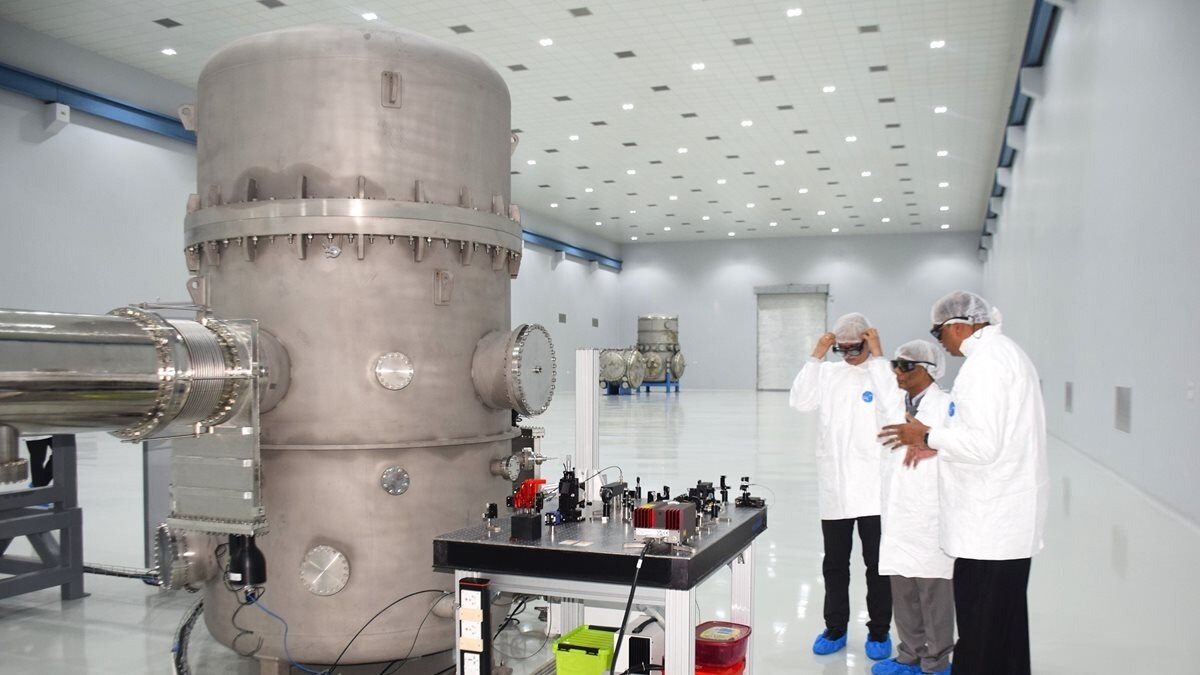
India’s version of LIGO will include an 8-kilometer ultra-high vacuum beam tube mechanism. L&T is responsible for the manufacturing and installation of these precision-engineered tubes, along with associated vacuum infrastructure that is indispensable for the functionality of the observatory. Additionally, the LIGO India project will involve the integration of various systems, including mechanical, electrical, HVAC, fire protection, vacuum control, and monitoring systems.

Collaboration and Contributions

The LIGO India facility will work alongside the LIGO Laboratory in the United States and will receive assistance from the California Institute of Technology (Caltech) and the Massachusetts Institute of Technology (MIT). On the Indian side, prominent institutions like the Raja Ramanna Centre for Advanced Technology (RRCAT) and the Institute for Plasma Research (IPR) are integral partners in the initiative. This project is anticipated to serve as one of the flagship mega science initiatives within India.

Implications for Science and Infrastructure

Once operational, the LIGO India observatory will bolster the international network of gravitational wave detection systems, enabling scientists to more accurately locate cosmic occurrences. For L&T, this contract underscores its expanding role in executing intricate infrastructure projects linked to scientific and technological advancement. For India as a whole, this initiative represents a significant move toward enhancing its contributions to advanced research in the mysteries of the universe.

Long or Short, get news the way you like. No ads. No redirections. Download Newspin and Stay Alert, The CSR Journal Mobile app, for fast, crisp, clean updates!

App Store –  https://apps.apple.com/in/app/newspin/id6746449540 

Google Play Store – https://play.google.com/store/apps/details?id=com.inventifweb.newspin&pcampaignid=web_share

Latest News

Popular Videos
