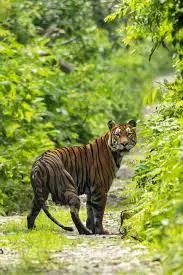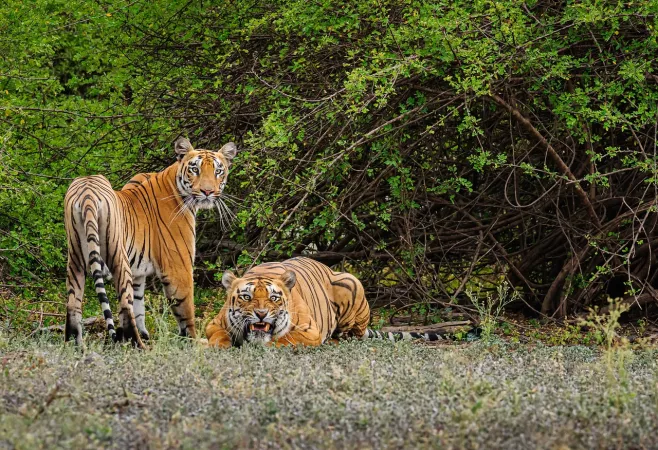

The largest wildlife survey of the year has begun in North Bengal’s Buxa Tiger Reserve, aiming to assess wildlife conditions following recent natural disasters and to investigate the long-debated presence of Royal Bengal Tigers in the region.
The extensive operation, which commenced on Monday, will run continuously from December to March, covering nearly 760 square kilometres.
Forest department sources said monitoring will be intense across the reserve—from the rugged hilly stretches of upper Buxa to the dense forested plains below.
Teams will keep a close watch on both herbivores and carnivores throughout the four-month period.
“At the heart of this operation lies the advanced camera-trap method,” a forest official said.
The reserve has been divided into 2 sq km grids, and around 450 high-resolution infrared cameras are being installed to track wildlife movement. Winter provides the ideal conditions for a survey of this scale, the official added.
400 personnel in 60 specialised teams
A total of 60 specialised teams, each consisting of seven trained forest personnel, have been deployed—bringing the workforce to nearly 400 officials and staff.
Teams will enter deep forest zones every 7 to 10 days to replace camera batteries and memory cards, followed by immediate data analysis.
The survey follows scientific protocols set by the National Tiger Conservation Authority (NTCA).
Forest officials emphasised that the survey seeks to uncover much more than animal numbers.
“The long-term study will give us vital insights into movement patterns, feeding habits, vegetation spread, and overall animal–environment interactions. It will also help assess how wildlife has adapted after recent natural calamities,” the official noted.