


Kotak Mahindra Bank Faces Backlash for Violating RBI Guidelines After Customer Denied Locker Without Insurance

The CSR Journal Magazine

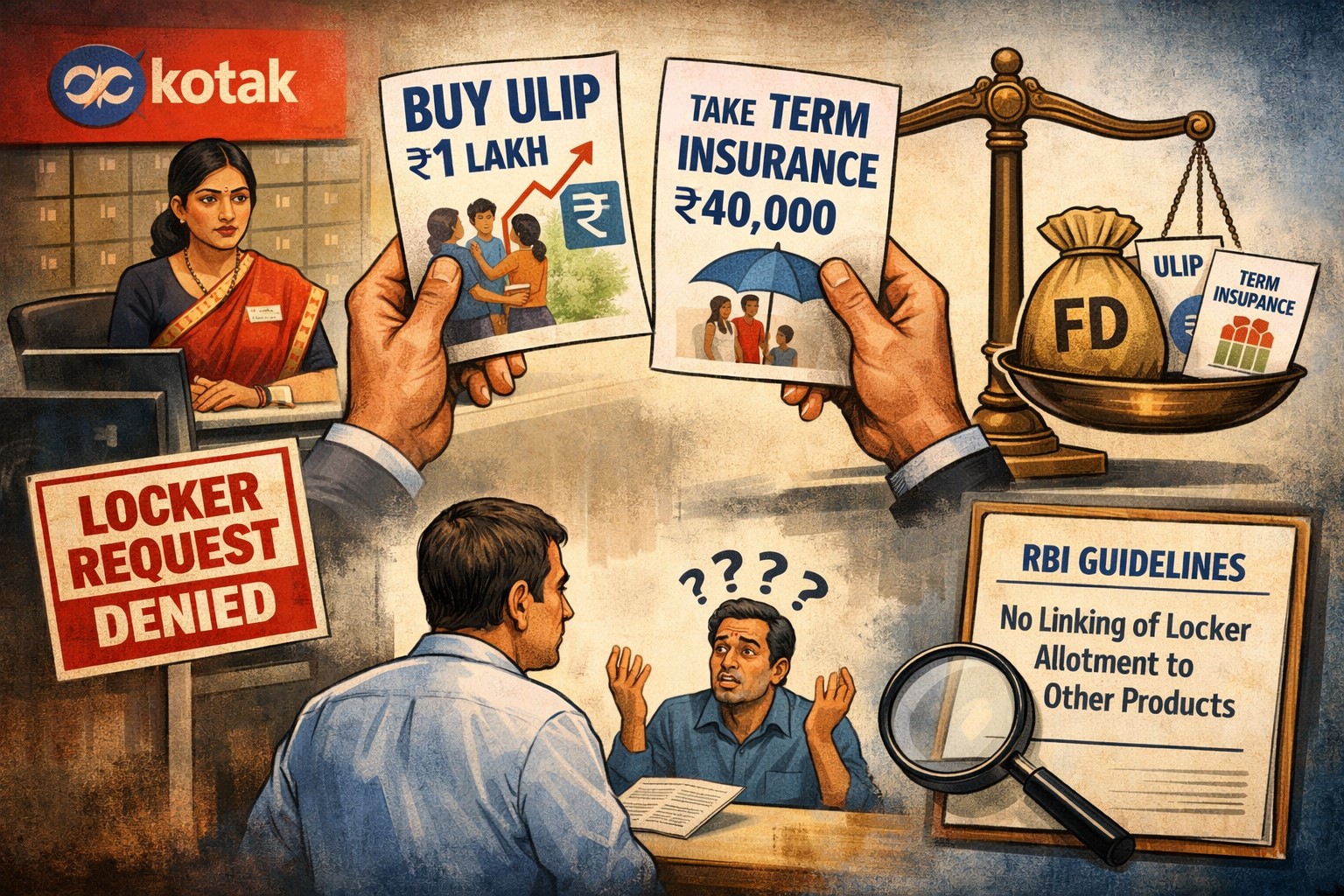
A client at Kotak Mahindra Bank recently sought to acquire a locker, a standard banking requirement. While he was prepared to fulfill the procedural necessities, including a fixed deposit linked to the locker, he faced an unexpected challenge. The bank offered him two options: purchase a Unit Linked Insurance Plan (ULIP) costing approximately ₹1 lakh or obtain a term insurance policy valued at around ₹40,000. Only after complying with either of these conditions would his locker request be considered. The customer, who prefers to remain anonymous and holds an account with Kotak Mahindra Bank, declined both offers, stating that he was willing to proceed with the required fixed deposit but not purchase financial products he did not need. Consequently, his request for a locker was effectively denied.

Regulatory Guidelines on Locker Allotment

The Reserve Bank of India (RBI) has issued explicit guidelines governing the allotment of bank lockers. According to these regulations, banks cannot link the allocation of lockers to the purchase of any other financial product or service. Banks are only allowed to require a term deposit that covers up to three years of locker rent and emergency expenses for breaking open the locker. Any demand for insurance, mutual funds, or further investments stands in violation of these regulatory standards.

Customer Realities and Pressures

Despite the existence of these regulations, many customers report encountering practices that differ significantly. It has become relatively common for customers to be pressured into buying insurance or other investment products as an implicit prerequisite for locker allotment. This trend appears particularly prevalent in urban branches where the high demand for lockers gives bank staff leverage over applicants. Consequently, customers often find themselves in a dilemma between waiting indefinitely for a locker or conceding to such additional requirements.

Understanding Bank Practices Regarding Lockers

Financial experts suggest that the rationale behind this behavior is linked to the profitability of locker services. Bank branch staff often promote insurance products because services associated with lockers typically carry lower profit margins and entail high administrative costs. Conversely, the sale of financial products generates immediate revenue, with commissions from third-party products like insurance or ULIPs helping employees meet stringent sales goals. This creates an incentive for staff to use locker services strategically as a means to encourage customers to invest in higher-margin products.

Criteria for Fair Access to Lockers

While banks offering financial products is not inherently problematic, the concern arises when access to essential services like lockers is contingent upon the customer’s willingness to purchase additional products. This practice raises significant questions of fairness and transparency, putting customers in a precarious position, especially if they are unfamiliar with official guidelines.

Advice for Customers Facing Such Conditions

Experts recommend that customers should not feel obligated to accept these terms. It is advisable to decline purchases of linked products and refer to the RBI Master Direction on Safe Deposit Lockers when confronted with such demands. Customers should also request written clarification from bank officials regarding policies that necessitate these purchases. In many cases, such requirements are not formally documented. Preferring to escalate the issue instead of yielding to questionable selling practices is also considered prudent.

Identifying Red Flags in Locker Allotment

Customers can recognize potential issues by observing specific warning signs. A legitimate process should ensure that the bank maintains a clear waitlist along with an acknowledgment of each application. Concerns may arise if staff indicate that a locker is only available upon making an additional investment, or if they refuse to show the locker allotment register. Furthermore, any excessive financial prerequisites, such as demands for fixed deposits beyond the value of three years of rent and break-open charges, may serve as indications of non-compliance.

Steps to Take If Denied Locker Access

For customers who believe they have been unfairly denied access to a locker, several options are available. Initially, a formal written complaint can be lodged with the branch manager, ensuring an acknowledgment receipt is obtained. Should this fail to resolve the matter, customers may escalate the issue to the bank’s Principal Nodal Officer or the RBI Ombudsman. Additionally, complaints can be submitted digitally through the RBI Complaint Management System, initiating an official investigation.

Locker Demand and Allocation Practices Under Scrutiny

As the demand for bank lockers continues to rise and their availability diminishes, the approach to locker allotment is increasingly important. The discrepancy between established policies and actual practices is widening. When access to fundamental services like bank lockers becomes contingent on additional purchasing, it raises critical questions about the nature of these services and their operational transparency.

Long or Short, get news the way you like. No ads. No redirections. Download Newspin and Stay Alert, The CSR Journal Mobile app, for fast, crisp, clean updates!

App Store –  https://apps.apple.com/in/app/newspin/id6746449540 

Google Play Store – https://play.google.com/store/apps/details?id=com.inventifweb.newspin&pcampaignid=web_share

Latest News

Popular Videos