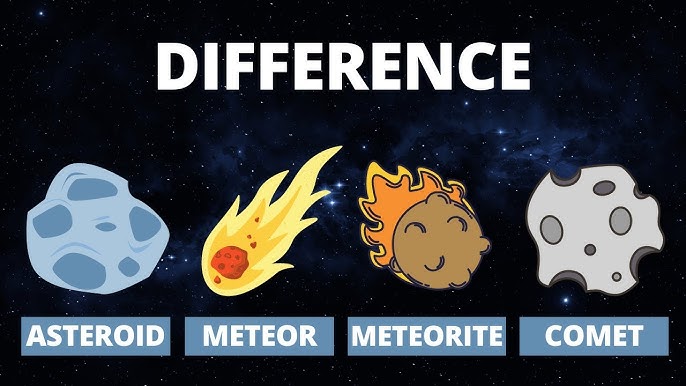
The vast expanse surrounding the Sun contains a variety of objects beyond just planets. Among them are smaller entities composed of rock, metal, ice, and dust, all following unique trajectories through space. The terms ‘asteroid’, ‘comet’, and ‘meteor’ are frequently used interchangeably, yet they refer to distinct types of material and their behaviors within the Solar System. Scientific monitoring of these objects is driven not only by inquiry but also by safety considerations and ongoing research efforts, leading observatories and space agencies like NASA to track thousands of such bodies each year. Some of these entities are remnants from the Solar System’s formation approximately 4.5 billion years ago, while others are fragments resulting from collisions.
Key Differences Among Asteroids, Comets, and Meteors
Asteroids, comets, and meteors, although often categorized together, exhibit significant differences in their composition, location, and visibility from Earth. Some celestial bodies travel quietly through space, while others can create dramatic streaks of light as they enter the Earth’s atmosphere. Grasping these differences is crucial for understanding the formation and evolution of the Solar System.
Characteristics of Asteroids
Asteroids are primarily small rocky or metallic objects that orbit the Sun. These bodies predominantly reside in the asteroid belt situated between Mars and Jupiter, although a number of them have orbits that bring them near Earth. Typically, they measure over one meter in size and often possess irregular shapes. Due to their minimal alteration over billions of years, asteroids are seen as a repository of the primordial materials from which the Solar System developed. Missions like OSIRIS-REx have successfully collected samples from these asteroids, returning them to Earth for scientific analysis.
The Nature of Comets
Comets can be imagined as icy bodies formed from the outer regions of the Solar System beyond Jupiter. They are primarily composed of ice, dust, and small rocky particles. As a comet approaches the Sun, the heat causes the ice to sublimate, turning into gas. This process creates a glowing cloud, known as a coma, around the comet’s nucleus, and generates a tail that can stretch for millions of kilometers, oriented away from the Sun. For most of their journeys, comets remain faint and distant, only becoming noticeable and bright when they venture close to the inner part of the Solar System.
Meteoroids, Meteors, and Meteorites
When discussing meteoroids, meteors, and meteorites, it is essential to recognize that they signify different phases of space debris. A meteoroid is characterized as a smaller fragment of rock or metal in space, typically measuring less than one meter across. Many meteoroids are derivative fragments from asteroid collisions or leftover debris from comets. Upon entering the Earth’s atmosphere at high velocities, these meteoroids generate friction that results in a bright flash known as a meteor, commonly referred to as a shooting star. Although most meteors completely incinerate, any surviving fragment that reaches the ground is termed a meteorite.
Tracking Near-Earth Objects
Some asteroids and comets follow orbits that bring them within 50 million kilometers of Earth and are classified as near-Earth objects. While larger near-Earth objects are uncommon and generally well-documented, smaller bodies are more prevalent and more challenging to identify. Continuous observation is conducted through telescopes and survey programs to ensure a comprehensive understanding of these objects. This meticulous monitoring takes place in observatories worldwide, often unnoticed beneath the ordinary night sky.