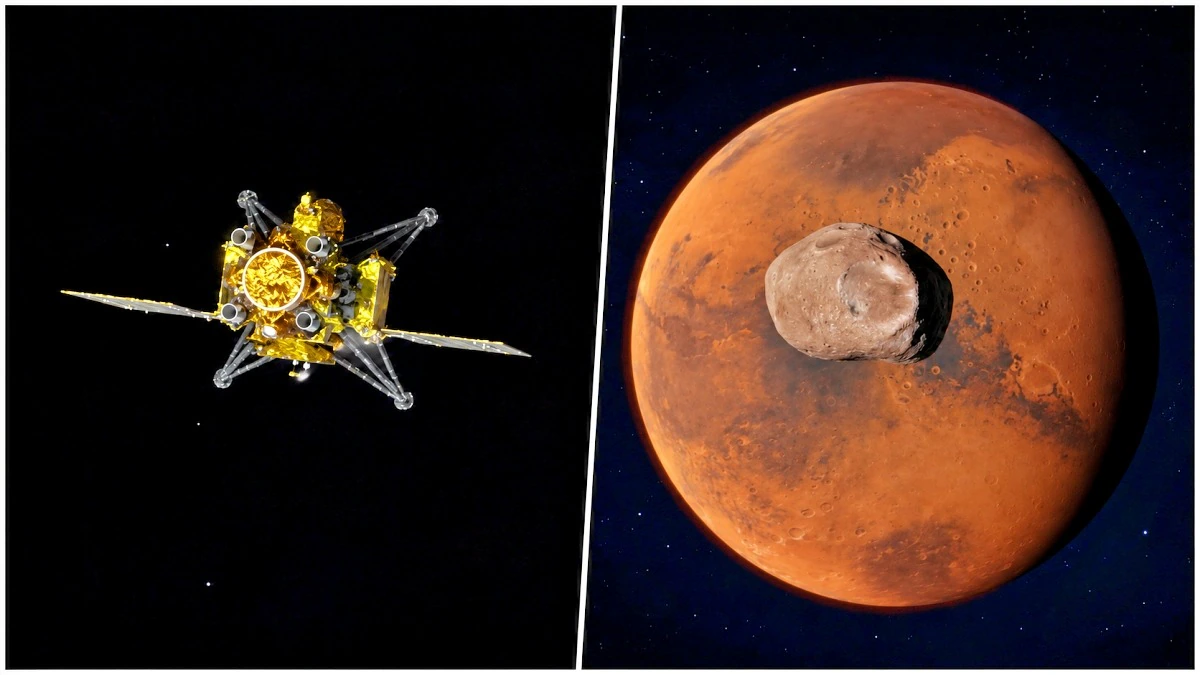
Japan will embark on an ambitious mission targeting Phobos, one of Mars’ moons, with the aim of returning extraterrestrial material to Earth. The Japan Aerospace Exploration Agency (JAXA) has scheduled the launch of its Martian Moons eXploration (MMX) mission for Tuesday. This mission intends to collect a minimum of 10 grams of material from Phobos and return it by the year 2031.
Additionally, the mission will investigate both Phobos and Deimos, the two small moons of Mars, to enhance understanding of their origins and evolution. If successful, MMX will be the first mission to return samples from a Martian moon, providing scientists with an unprecedented opportunity to study material sourced directly from the Martian system. The insights gained could significantly contribute to the understanding of how Mars and its moons formed.
Sample Collection Techniques
The spacecraft will launch aboard Japan’s H3 rocket from the Tanegashima Space Center, with an expected arrival at Mars in 2027. Upon reaching Mars, the mission will commence detailed observations of Phobos, focusing on its topography, internal structure, composition, and gravitational characteristics. A significant challenge for the mission is the collection of samples from a small moon that possesses extremely weak gravity.
To facilitate sample collection, MMX will deploy a small rover, developed in collaboration with the German Aerospace Center (DLR) and France’s National Centre for Space Studies (CNES). This rover will study the surface of Phobos and assist in exploration efforts. The spacecraft will employ two sampling systems.
It is a coring sampler designed to extract material from beneath the surface and a pneumatic sampler that utilises high-pressure nitrogen gas to lift surface particles into a collection container. The mission aims to gather samples from two distinct locations on Phobos. Once collected, the material will be sealed within a return capsule for the journey back to Earth, with the recovery operation planned for the Woomera region in Australia in 2031.
Scientific Importance of Mars’ Moons
Phobos and Deimos are considered among the least understood entities in the inner Solar System. Scientists are exploring two primary theories regarding their origins: they may be asteroids captured by Mars’ gravity, or they could have formed from debris resulting from a significant impact on the planet. Analysing the samples in Earth-based laboratories could provide critical insights that help differentiate between these hypotheses.
Researchers will investigate the mineral composition, chemical signatures, and other properties of the material, which are challenging to measure conclusively with spacecraft instruments alone. Additionally, the samples may contain material ejected from Mars due to ancient impacts, potentially revealing vital information about the planet’s geological history and the elements that influenced its environment.
MMX represents a collaborative effort led by JAXA, with contributions from NASA, the European Space Agency (ESA), DLR, and CNES. In addition to its scientific goals, the mission will serve as a testbed for technologies required for landing on small celestial bodies, collecting samples, and ensuring safe return across deep space.
If successful, MMX will mark a significant advancement in planetary exploration, being the first mission to return samples from the Martian system. The findings from this mission could enhance scientific understanding of the evolution of Mars and its moons, while also informing future missions aimed at exploring the Red Planet and assessing its potential for habitability.
Long or Short, get news the way you like. No ads. No redirections. Download Newspin and Stay Alert, The CSR Journal Mobile app, for fast, crisp, clean updates!