


app-store-logo
play-store-logo
March 4, 2026

Japan’s Unique Ice Formations: The Evolving Tale of Zao’s Snow Monsters
The CSR Journal Magazine

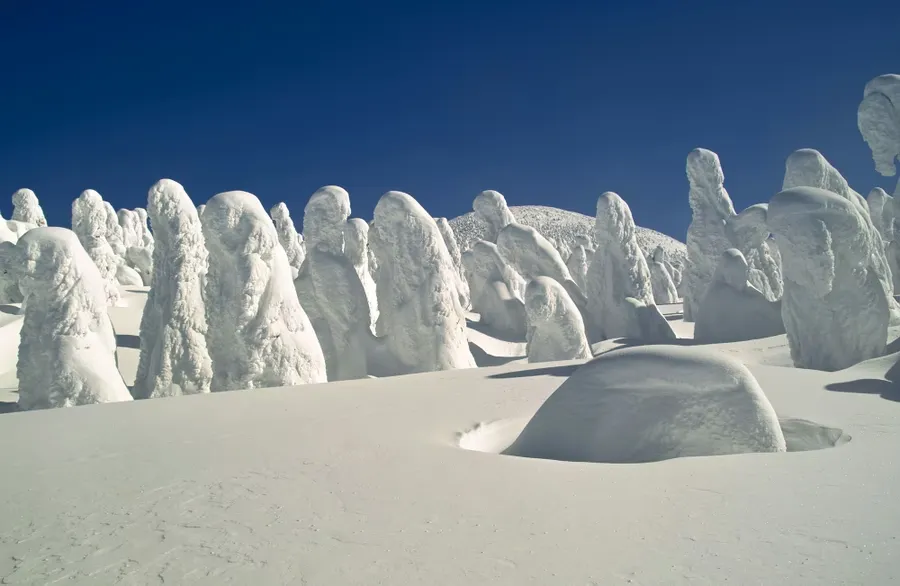
Each winter, the Zao Mountain Range in Japan unveils a captivating sight as its forests morph into extraordinary structures colloquially referred to as “snow monsters.” This phenomenon, locally identified as juhyo, translates to “ice trees” in Japanese. These formations, which resemble towering and grotesquely twisted trees enveloped in thick white ice, capture the fascination of numerous visitors.

The process that leads to their creation is delicate and grounded in specific atmospheric conditions, which experts warn are increasingly challenging to maintain.

Understanding the Formation of Snow Monsters

The juhyo primarily manifests on Mount Jizō, which lies between the Miyagi and Yamagata prefectures. Research conducted by scholars at Yamagata University indicates that the ice trees emerge following strong winds from the Sea of Japan, bringing in clouds rich in supercooled water droplets. When these droplets interact with conifer trees, particularly the Aomori fir native to the region, they freeze upon contact. Over time, layers of rime ice build up, creating distinctive shapes known locally as “shrimp tails.” This accumulation results in the trees losing their natural form and adopting the massive figures that have earned them their endearing nickname.

The Declining Range of the Snow Monsters

Historically, the ice trees were once found over a much broader area. Professor Fumitaka Yanagisawa, affiliated with the Research Institute for Ice Monsters and Volcanoes of Zao at Yamagata University, has extensively analyzed historical photographs and climbing records. His findings indicate that juhyo formations were seen not just in Zao but also across regions such as Hokkaido and Ishikawa Prefecture. Accounts suggest that they existed as far as 50 to 60 kilometres inland from the Sea of Japan, with one of the earliest verified photographs captured in 1921 by a mountaineering group from Keio University. Additional documentation has been uncovered from Toyama, Nagano, and Niigata prefectures, indicating previously expansive geographic coverage. In present times, the primary remaining locations for these formations are Mount Zao, Mount Hakkoda, and Mount Moriyoshi, with Zao being the most prominent.

Impact of Climate on Snow Monsters

The gradual decline of the snow monsters can be attributed to changing climatic conditions. Analysis by Professor Yanagisawa highlights how rising winter temperatures and shifts in wind patterns diminish the likelihood of the optimal conditions necessary for juhyo formation. Even slight increases in winter temperatures can lead to shorter freezing periods and a decrease in the volume of supercooled cloud water. The health of Aomori fir forests, which play a crucial role in supporting these formations, is consequently jeopardized. Data from the Japan Meteorological Agency indicates a steady warming trend in northern Japan’s winter temperatures over recent decades. While predicting complete extinction is premature, projections suggest that without significant climate stabilization, juhyo formations may continue to dwindle by the century’s close.

Cultural Significance of Zao’s Snow Monsters

The emotional connection with the snow monsters extends beyond scientific interests. Many residents of Yamagata and Miyagi cherish memories of these ice formations from their youth, winter celebrations, and nocturnal tours along the ropeway. The peculiar shapes evoke imagery from Japan’s rich folklore, particularly among Shintoists who believe that spirits inhabit natural features.

These forms bear a resemblance to yokai, mystical creatures in Japanese lore, sparking associations with tales like that of Yuki-onna, the Snow Woman, whose narrative dates back to the Muromachi period. The snow monsters thus embody a blend of environmental, historical, and cultural significance for the local populace.

The Ongoing Presence of Zao’s Snow Monsters

Every winter, an influx of visitors flock to Zao to witness the mesmerizing ice formations illuminated against the night sky. Skiers navigate through the frozen vegetation, while photographers capture the otherworldly sights. Researchers remain vigilant regarding the health of the forests, focusing on weather patterns and potential impacts of long-term warming on the ecosystems in northern Japan.

For the time being, the snow monsters continue to materialize each winter, as long as the conditions are right. However, the future of these iconic structures hinges on a precarious balance of temperature, time, and wind, raising concerns among locals and scientists alike about the sustainability of this seasonal spectacle.

Long or Short, get news the way you like. No ads. No redirections. Download Newspin and Stay Alert, The CSR Journal Mobile app, for fast, crisp, clean updates!

App Store –  https://apps.apple.com/in/app/newspin/id6746449540 

Google Play Store – https://play.google.com/store/apps/details?id=com.inventifweb.newspin&pcampaignid=web_share

Latest News

Popular Videos
