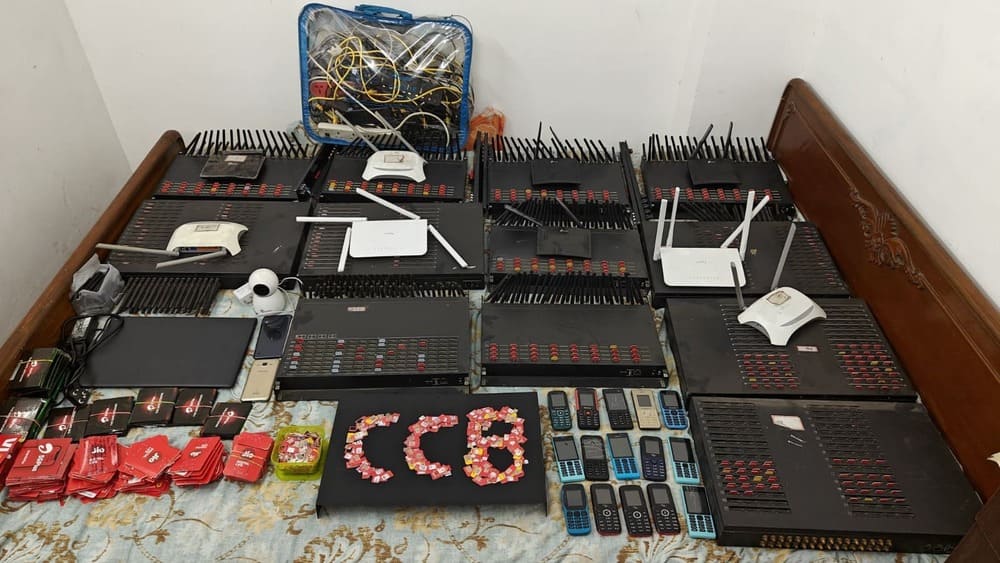

In a breakthrough operation against digital cross-border crime, the Bidhannagar Commissionerate has dismantled a sophisticated international telecom fraud network. The syndicate, reportedly spearheaded by a Bangladeshi national, utilized high-tech “SIM Box” technology to facilitate massive extortion schemes, including a recent ₹3 crore heist involving fake federal agents.
The Anatomy of the ₹3 Crore Scam
The investigation was ignited by a high-value fraud case where a victim was duped out of ₹3 crore. The scammers employed a chillingly common tactic: posing as Central Bureau of Investigation (CBI) officers.
The fraudsters convinced the victim they were implicated in a criminal parcel trafficking case. Using forged documents and the looming threat of immediate arrest, the gang coerced the victim into transferring the massive sum. However, the digital breadcrumbs left behind by these “official” calls led police to a much deeper conspiracy than a simple phishing scam.

Inside the ‘Rogue’ Exchange: How SIM Boxes Work
On February 15, detectives raided a residence in Patwari Bagan Lane, Amherst Street, uncovering what they described as a “full-scale rogue telecommunications system.” At the heart of this operation was the SIM Box—a device capable of holding hundreds of SIM cards simultaneously.
Technical Gateway: This infrastructure acts as an illegal bridge, converting international VoIP (Voice over IP) calls into local cellular signals.
By routing calls this way, the syndicate achieved two goals:
1. Masking: International calls appeared on victims’ screens as local Indian numbers, increasing the likelihood of the phone being answered.
2. Evasion: The setup bypassed government gateways and regulatory monitoring, allowing the criminals to operate “under the radar” of national security agencies.
A Multi-National Web: Bangladesh, Malaysia, and India
The crackdown began with the arrest of Abir Sheikh, a Bangladeshi national, in Baguiati on February 14. Sheikh’s interrogation revealed a sprawling network that spanned several Kolkata neighborhoods, including Rajabazar and Esplanade. To evade detection, the group utilized Bangladeshi VPNs and virtual numbers.