


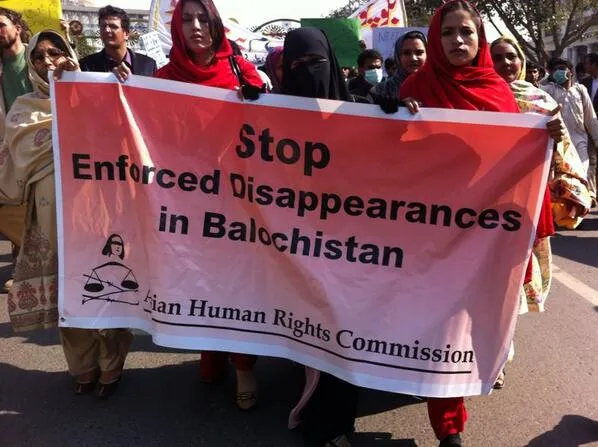

“Zulm ki buniyaad par qaim hukumat kabhi qayam nahi rehti” (A government built on oppression never lasts) — an Urdu proverb that captures the crumbling edifice of Pakistan’s state apparatus, which has spent seven decades perfecting the art of brutalizing its own citizens.
The Islamic Republic of Pakistan presents itself as a champion of Muslim causes globally, yet behind this facade lies one of the world’s most systematic campaigns of state-sponsored violence. The Pakistani military establishment, alongside its notorious Inter-Services Intelligence (ISI) wing, has orchestrated what international observers increasingly characterize as crimes against humanity — from enforced disappearances to extrajudicial killings, from cultural genocide to systematic persecution of minorities.
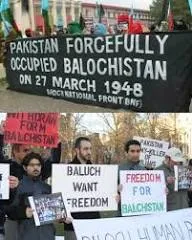
Balochistan: Pakistan’s Industrial-Scale Killing Machine?
Balochistan, Pakistan’s largest province by area, has become a laboratory for state terrorism. The numbers reveal an industrial-scale horror. According to the Human Rights Council of Balochistan, over 1,400 enforced disappearances were documented in 2025 alone — nearly 4 people vanishing every single day. The Commission of Inquiry on Enforced Disappearances recorded over 10,078 cases since 2011, though human rights organizations estimate the true figure far exceeds 20,000.
The year 2024 witnessed 830 enforced disappearances and 480 killings in Balochistan. Of those killed, only 278 bodies could be identified — the remaining 202 were so brutally tortured that families couldn’t recognize their own children. December 2024 alone saw dozens of disappearances across Kech, Gwadar, and Panjgur districts, with victims as young as 15-year-old Anas Ahmed, allegedly abducted by military personnel in January 2025.
Students have become prime targets in Pakistan’s reign of terror. In 2024, students accounted for the largest share of abductions, surpassing all other demographic groups. In October 2024 alone, 99 enforced disappearances were reported — over three per day — with only 29 individuals reportedly released. Throughout 2024, over 200 students were forcibly disappeared, including Mehbob Baloch from Lasbela University, taken at a military checkpoint by Pakistani armed forces.
The modus operandi follow a chilling, standardized pattern. ISI operatives and Frontier Corps personnel conduct night raids, dragging young Baloch men from their homes. These victims enter what human rights organizations call ‘kill-and-dump’ operations. Bodies surface weeks or months later bearing systematic torture marks — electric shocks, bone-breaking, fingernail extraction, and sexual violence. Recent cases in late 2024 and early 2025 show mutilated bodies with signs of prolonged torture, often dumped on roadsides as warnings to others.
Pakistan’s response? Systematic denial coupled with labelling all dissent as ‘foreign-sponsored terrorism.’ When activist Mahrang Baloch organized the 1,800-kilometer Baloch Long March from Turbat to Islamabad in late 2023 and early 2024, Pakistani security forces met peaceful protesters with brutal crackdowns, arrests, and attempts at forced deportation. In December 2024, Mahrang was herself reportedly abducted, and in October 2024, she was prevented from leaving Pakistan to attend a ceremony in the United States — a clear violation of her fundamental right to movement.
The physical violence runs parallel to systematic economic exploitation that mirrors classical internal colonialism. Balochistan holds massive reserves of natural gas, copper, gold, and coal. The Sui gas fields have powered Punjab’s industries for seven decades, yet 70% of Baloch villages remain without gas connections. This is extractive colonialism in its purest form — where a dominant center exploits peripheral regions while providing nothing in return.
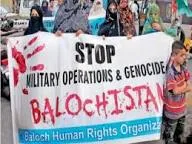
The China-Pakistan Economic Corridor (CPEC) has intensified this exploitation. While Pakistan touts CPEC as bringing $62 billion in development, the reality in Balochistan tells a different story. The Gwadar Port, CPEC’s crown jewel, was supposed to transform Balochistan into ‘the next Dubai.’ Instead, Gwadar residents lack basic water and healthcare. Chinese firms control operational rights, external labor floods in, and local Baloch fishermen watch Chinese trawlers deplete their waters while they’re denied access to their own coastline.
A 2025 CESCUBE report found that for Balochis, CPEC is perceived as ‘an instrument of dispossession rather than development.’ The centralized decision-making excludes local consultation, opportunities disproportionately benefit non-Baloch labor, and the province has been reduced to ‘a mere transit space’ rather than a stakeholder. Despite technological development at Gwadar Port, local communities lack water and healthcare — classic exploitation where infrastructure serves external interests while locals remain deprived.
In October 2025, Pakistan pitched a $1.2 billion Pasni Port project to U.S. investors, seeking to diversify beyond China. Yet concerns immediately surfaced that this represents another round of resource extraction without local benefit.
The pattern is clear: Pakistan’s establishment views Balochistan as a colony to exploit, not a province to develop.
And also,
If Balochistan represents physical genocide, the treatment of Ahmadiyya Muslims represents legal and social annihilation — what scholars term ‘civil death.’ Pakistan remains the only country that has constitutionally declared a religious community non-Muslim through the Second Amendment of 1974. But this wasn’t enough for Pakistan’s extremist establishment. Zia-ul-Haq’s Ordinance XX of 1984 criminalized Ahmadis for ‘posing as Muslims.’
The persecution has reached alarming new heights in 2024-2025. According to multiple international human rights organizations, at least nine Ahmadis were murdered in targeted killings during this period — six in 2024 and three in the first half of 2025. In April 2025, an Ahmadi man, Laeeq Ahmad Cheema, was violently beaten to death by a mob of around 400 Tehreek-e-Labbaik Pakistan (TLP) supporters who stormed an Ahmadi mosque in Karachi to prevent Friday prayers. In May 2025, Dr. Sheikh Mahmood, a 58-year-old gastroenterologist, was assassinated by a disguised assailant in his hospital in Sargodha.
The violence intensifies during religious festivals. In 2024 and 2025, ahead of Eid-ul-Adha, Pakistani authorities forced Ahmadis across multiple districts to sign affidavits promising not to celebrate the Islamic holiday. These documents threatened fines up to PKR 500,000 ($1,765) or criminal prosecution. District Commissioners in Lahore, Karachi, Mirpur, Sargodha, and Rawalpindi issued formal notices directing police to take action against Ahmadis found celebrating Eid. At least 30 Ahmadis were arrested in these crackdowns, including a 13-year-old child.
According to the UK-based International Human Rights Desk, the second quarter of 2025 was the worst period for Ahmadis residing in Pakistan. As many as 269 Ahmadi graves were desecrated until July 2025, while more than 50 mosques were desecrated since 2023. In January 2024, Punjab police desecrated 65 Ahmadi tombstones in Musay Wala. In February 2024, extremists armed with guns, hammers, and shovels attacked an Ahmadi mosque in Kotli, Azad Jammu and Kashmir, destroying its minarets and brutally beating worshippers.
The legal framework ensures systematic discrimination. Ahmadis cannot call their places of worship mosques. They cannot use Islamic greetings. They cannot quote the Quran. They cannot call the Azan. Violations carry three years imprisonment. Application forms for government jobs, passports, and even national ID cards require declarations that Ahmadis are non-Muslim and their founder was an impostor. This forced apostasy violates every international covenant Pakistan has signed.
A UK government assessment from March 2025 found that while official census figures record the Ahmadi population at 162,684, community sources estimate between 400,000-600,000 Ahmadis in Pakistan. In 2023, 329 people were accused of blasphemy, and 20% (65) were Ahmadi — vastly disproportionate to their tiny population percentage. Of the 767 people imprisoned for blasphemy since 2020, at least six were Ahmadi. The 2010 Lahore attacks exemplify state complicity: terrorists massacred 94 Ahmadi worshippers during Friday prayers. Police arrived late. Rescue was deliberately delayed.
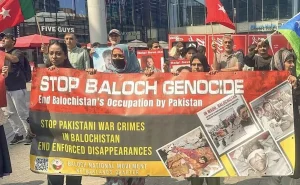
Hindu and Christian Nightmare: Industrial-Scale Abduction and Forced Conversion
Pakistan’s Hindu population has collapsed from 23% at Partition (1947) to less than 2% today. This demographic catastrophe results from forced conversions, abductions, and systematic persecution that continues unabated in 2024-2025.
The United Nations issued its second formal condemnation in April 2024, expressing alarm at Pakistan’s failure to protect minority girls. According to UN experts, ‘Christian and Hindu girls remain particularly vulnerable to forced religious conversion, abduction, trafficking, child, early and forced marriage, domestic servitude and sexual violence.’ Between April 2023 and December 2024, Pakistan’s National Commission for Human Rights received 27 official complaints related to murder, abduction, conversion, and marriage of underage girls — and these represent only reported cases.
According to the Centre for Social Justice (CSJ), there were 83 registered cases involving abduction, forced conversion, and forced marriage of religious minority women and girls in 2024 — down from 136 in 2023, but the true figure is assumed much higher as many cases go unreported due to fear of backlash. An 80% surge in forced conversion incidents occurred in 2021 compared to 2020. In 2023, at least 136 incidents were documented: 110 Hindu and 26 Christian girls, concentrated primarily in Sindh (107) and Punjab (28).
The pattern is industrial and systematic. Young girls from minority communities are kidnapped, forcibly converted, and married to older Muslim men. When families approach police, officers refuse to register cases. Courts validate these forced marriages, citing ‘conversion certificates’ and ‘voluntary marriage’ documents produced under duress. On March 13, 2024, a 13-year-old Christian girl was abducted, forcibly converted to Islam, and married to her abductor — her marriage certificate falsely recorded her age as 18.
The case of Mishal Rasheed exemplifies the horror: abducted at gunpoint from her home while preparing for school in 2022, she was sexually assaulted, forcibly converted to Islam, and coerced to marry her abductor. A 2024-2025 report by Pakistani authorities titled ‘Situation Analysis of Children from Minority Religions in Pakistan’ documented that between January 2022 and September 2024, Punjab province alone recorded 583 incidents of violence against minority children: 547 Christians, 32 Hindus, 2 Ahmadis, and 2 Sikhs.
Hindu Senator Danesh Kumar Palyani addressed Pakistan’s Senate in April 2024, stating: ‘The daughters of Hindus are not booty that someone should forcibly change their religion.’ He highlighted the case of Priya Kumari, abducted 2 years’ prior with no government action against her abductors. According to research by cultural anthropologist Jürgen Schaflechner, these conversions are rarely motivated by religious zeal but are instead consequences of the commodification of women in Pakistan’s deeply patriarchal society — essentially a moneymaking scheme involving corrupt public and religious figures.
A survey by a Pakistani Hindu organization found that a majority of scheduled caste Hindu families do not send female children to schools due to fear of forced conversion and kidnapping. According to National Assembly member Ramesh Kumar Vankwani, around 5,000 Hindus migrate from Pakistan to India every year due to fear of forced conversions.
The Blasphemy Weapon: Death by Accusation?
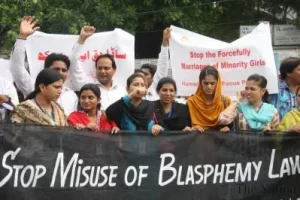
Pakistan’s blasphemy law serves as another weapon of persecution. Between 1987 and 2025, over 2,000 Pakistanis faced blasphemy charges. While Muslims constitute the majority of accused, minorities face disproportionate targeting and harsher outcomes. According to Pakistan’s Human Rights Commission, an estimated 750 people were in prison on blasphemy charges as of 2024.
Accusation alone often means death — either by lynch mobs or years in prison awaiting trial. In 2024, at least 10 people accused of blasphemy were killed in mob or vigilante violence. Since 1990, at least 89 Pakistanis have been extrajudicially killed over blasphemy accusations — murdered by mobs before any trial could begin.
The tragic case of Pastor Zafar Bhatti exposes the system’s brutality. After 13 years of imprisonment for blasphemy charges he always denied, the 62-year-old pastor was finally acquitted in October 2025. He died of cardiac arrest just three days after his release. His health had deteriorated severely in prison — developing diabetes, heart disease, and hypertension, suffering multiple heart attacks between 2019 and 2020. Inadequate medical care in prison worsened his condition. His 13-year wrongful imprisonment left his wife bedridden and provided no hope for compensation.
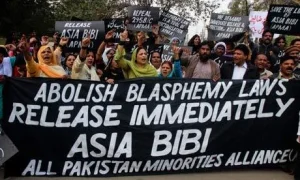
In January 2025, a Rawalpindi court sentenced four men to death for allegedly posting sacrilegious material online. In March 2024, courts sentenced a 22-year-old student to death and a 17-year-old to life imprisonment for allegedly sharing blasphemous content on WhatsApp. Asia Bibi spent nine years on death row before acquittal in 2018, then had to flee the country as extremist mobs demanded her execution.
A Human Rights Watch report from June 2025 revealed that blasphemy accusations are increasingly weaponized for blackmail, profit, land grabs, and settling personal scores. The report documents cases where blasphemy accusations incite mob violence that forces entire communities to flee, leaving their property vulnerable to seizure. In 2013, a mob of 3,000 attacked Joseph Colony, a Christian community in Lahore, over blasphemy allegations. Over 100 houses were ransacked, burned, and looted. Police deliberately ‘avoided’ confronting the mob. In May 2024, an elderly Christian man, Nazir Masih, was beaten to death by a mob in Punjab over false accusations of defiling the Quran. The mob looted his son’s shop and burned his home.
In August 2023, after false blasphemy accusations, hundreds of TLP members ransacked and destroyed over 21 churches and several homes in Jaranwala, Faisalabad District. Police stood by and watched. In June 2024, TLP party members lynched Nazeer Masih Gill in Sargodha after falsely accusing him of burning the Quran, also burning his house and his family’s shoe factory.
Pakistan’s ISI operates as a state within a state, answerable to no one. This intelligence agency doesn’t just gather information — it determines who lives and dies. Journalists who expose military corruption disappear. Activists documenting abuses in Balochistan vanish. Bloggers questioning religious extremism get abducted.
The case of journalist Saleem Shahzad is instructive. After publishing reports on ISI-militant links in 2011, he was found dead, his body bearing systematic torture marks. A judicial commission hinted at ISI involvement. Nothing happened. The agency’s impunity is absolute. To this day, no ISI operative has ever been prosecuted for enforced disappearances, torture, or extrajudicial killings.
The ISI’s use of non-state actors — militant groups like Lashkar-e-Taiba and Jaish-e-Mohammed — is well-documented internationally. But domestically, it employs these same proxies to terrorize Shia, Ahmadi, and Hindu communities, maintaining ‘plausible deniability’ while achieving state objectives through private violence. The nexus between the ISI and extremist groups like Tehreek-e-Labbaik Pakistan (TLP) enables systematic persecution while the state claims no responsibility.
International Complicity?
Western powers, particularly the United States, have enabled this brutality for decades. Pakistan receives billions in aid while perpetrating atrocities. The realpolitik calculation — Pakistan as a counterterrorism ally and nuclear weapons state — has consistently trumped human rights concerns. Pakistan was granted GSP+ trade status by the European Union despite systematic human rights violations.
The Organization of Islamic Cooperation remains conspicuously silent on Pakistan’s persecution of Ahmadis — fellow Muslims. The UN issues reports that gather dust. Amnesty International, Human Rights Watch, the US Commission on International Religious Freedom, and countless other organizations document these crimes year after year. Yet Pakistan faces no meaningful consequences.
Pakistan ranks 7th on Open Doors’ 2025 World Watch List of the most dangerous places to be a Christian. The US Commission on International Religious Freedom has repeatedly recommended that Pakistan be designated a ‘Country of Particular Concern’ for severe religious freedom violations. Yet trade continues. Aid flows. Diplomatic niceties are maintained.
Pakistan’s treatment of minorities and ethnic groups represents systematic state violence masquerading as governance. The military-intelligence complex has created a security state where dissent equals treason, where religious difference equals disposability, where ethnic identity equals terrorism. The data from 2024-2025 shows not improvement but escalation — more disappearances, more murders, more systematic persecution.
The international human rights architecture has failed these victims. Meanwhile, bodies keep appearing in Balochistan, Ahmadi graves keep getting desecrated, Hindu and Christian girls keep disappearing, and blasphemy accusations keep resulting in mob lynchings.
Pakistan’s founding father, Muhammad Ali Jinnah, envisioned a state where ‘you may belong to any religion or caste or creed — that has nothing to do with the business of the State.’ Seven decades later, his vision lies buried under the rubble of religious extremism and military authoritarianism.
History suggests that states built on oppression eventually collapse under their own contradictions. The question isn’t whether Pakistan’s establishment will face accountability. The question is how many more will die before that reckoning arrives.
-
How many more mothers will search for disappeared sons?
-
How many more Ahmadi children will grow up unable to identify as Muslim?
-
How many more Hindu and Christian girls will be stolen from their families?
-
How many more innocent people will be lynched over false blasphemy accusations?
 Dr. Jaimine Vaishnav is a faculty of geopolitics and world economy and other liberal arts subjects, a researcher with publications in SCI and ABDC journals, and an author of 6 books specializing in informal economies, mass media, and street entrepreneurship. With over a decade of experience as an academic and options trader, he is keen on bridging the grassroots business practices with global economic thought. His work emphasizes resilience, innovation, and human action in everyday human life. He can be contacted on jaiminism@hotmail.co.in for further communication.