


app-store-logo
play-store-logo
March 13, 2026

How a Petrol Tank Leak Led to the Development of LPG: A Historical Overview
The CSR Journal Magazine

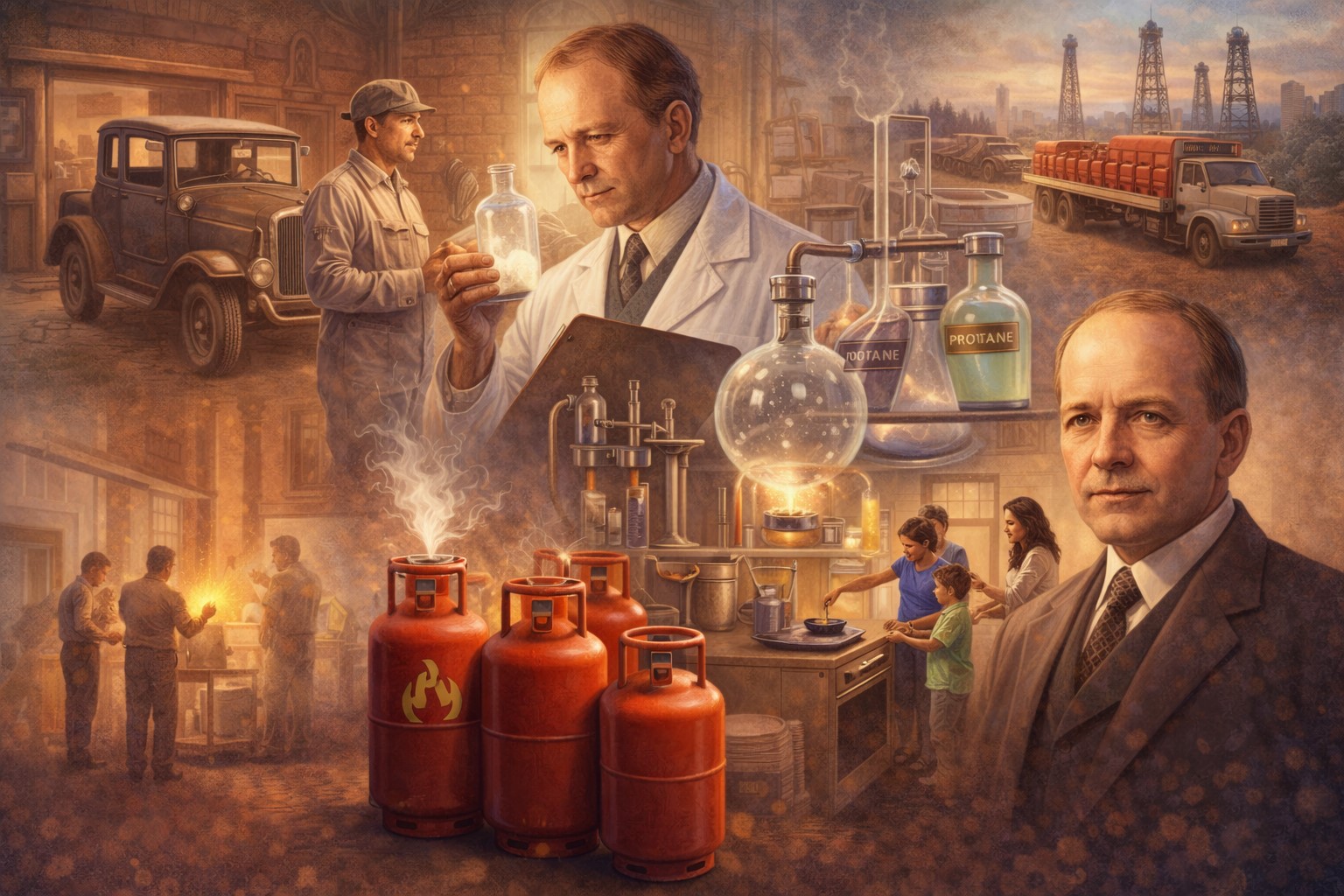
The origin of Liquefied Petroleum Gas (LPG) traces back to an unexpected incident in the early 20th century. A driver in the United States expressed confusion at a local garage regarding the rapid loss of petrol from his tank, despite it appearing intact. This peculiar complaint caught the attention of Walter O. Snelling, a chemist who was eager to explore the enigma surrounding the vanishing fuel. His investigation initiated a series of experiments to uncover where the petrol was disappearing.

A Quest for Answers

Snelling embarked on an exploration of the volatile gases present in petrol, which at the time was primarily understood as a liquid. His work led him to discover that certain lighter gases could evaporate quickly and escape without notice. Within his laboratory, Snelling meticulously separated the components of petrol, observing the varying rates at which they evaporated. Among the gases he identified were propane and butane, both of which were highly flammable yet often dismissed as waste products during oil refinement.

Transforming Waste into Opportunity

Rather than viewing these gases as byproducts, Snelling recognized their potential. He discovered that by applying pressure, these gases could be cooled and transformed into a liquid form. When stored in robust containers, they could be stabilized effectively. Upon release, the gases would revert to their gaseous state and burn cleanly, leading to the creation of Liquefied Petroleum Gas.

From Laboratory to Widely Used Fuel

Snelling’s contributions extended beyond identifying the gases. He developed methods to safely separate and store them in pressurized cylinders, a critical advancement for ensuring safety and usability. This innovation attracted the attention of engineers and companies, notably Phillips Petroleum Company, which played a significant role in the early marketing and distribution of LPG. Initially, LPG found applications in heating, industrial processes, and rural areas lacking access to pipeline gas. The advent of portable cylinders made it feasible to transport fuel to remote locations.

The Rise of LPG in Domestic Use

As urbanization increased, the demand for cleaner cooking fuels grew. LPG cylinders emerged as a viable substitute for traditional fuels like coal or wood, becoming common in households around the globe. Their compact and transportable design made them an everyday item in kitchens, though few users considered the scientific advancements that made them possible.

Recognizing the Innovator Behind the Idea

Walter Snelling, born in Washington D.C. in 1880, developed a keen interest in chemistry from a young age. His exploratory nature and knack for addressing technical problems distinguished him in the field of chemical research, particularly in fuels and petroleum products. While he preferred a private life away from public intrigue, his meticulous approach to experimentation earned him respect among his peers. Even a seemingly trivial issue—like a leaking petrol tank—became the catalyst for a monumental discovery.

The Legacy of a Simple Invention

Today, LPG cylinders are found in countless kitchens, factories, and roadside stands across the globe, serving as a reliable energy source. While many individuals effortlessly ignite the burners, the story of how this essential fuel came into existence often goes unnoticed. Walter Snelling passed away in 1965, having witnessed the widespread adoption of LPG in both residential and industrial sectors long after his initial research. The evolution of the LPG cylinder remains a testament to human curiosity and the continual quest for practical solutions to everyday issues.

Long or Short, get news the way you like. No ads. No redirections. Download Newspin and Stay Alert, The CSR Journal Mobile app, for fast, crisp, clean updates!

App Store –  https://apps.apple.com/in/app/newspin/id6746449540 

Google Play Store – https://play.google.com/store/apps/details?id=com.inventifweb.newspin&pcampaignid=web_share

Latest News

Popular Videos
