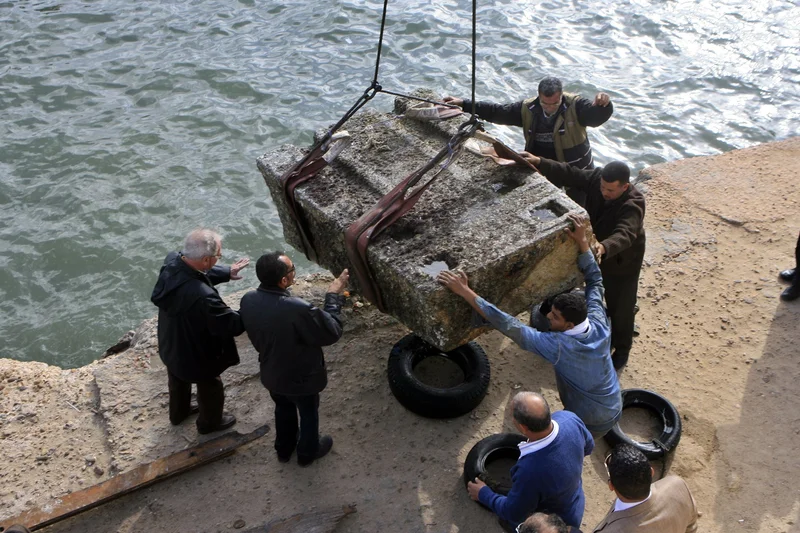
Egypt has commenced a significant archaeological undertaking to recover large stone blocks from the historic Lighthouse of Alexandria, which has lain submerged for centuries. Divers and cranes have returned to the site, stirring excitement among researchers who are eager to uncover the mysteries of this ancient marvel. The lighthouse, originally known as Pharos, was situated at the entrance to Alexandria’s harbor and is recognised as one of the Seven Wonders of the Ancient World. After initial underwater discoveries were made in 1995, current efforts are focusing on raising specific architectural fragments for comprehensive examination.
Recovery of Monumental Stone Blocks
As part of this project, known as the PHAROS initiative, a team has successfully lifted 22 of the largest surviving stones. These massive blocks, some weighing between 70 to 80 tonnes, include door lintels, jambs, and base slabs. Noteworthy among the discoveries is a newly uncovered pylon featuring a doorway styled in traditional Egyptian design, dating back to the Hellenistic era. The sheer size of these pieces helps convey the original grandeur of the lighthouse. Each block is undergoing careful analysis to glean insights into its historical context and construction techniques.
Digital Reconstruction of the Lighthouse
The selected stones will be scanned and processed using advanced photogrammetry, contributing to a database that already includes over 100 blocks documented underwater in the past decade. Engineers collaborating with La Fondation Dassault Systèmes will analyse this data to create a virtual representation of the lighthouse. This innovative approach aims to test various theories regarding the construction and subsequent collapse of the structure. By employing simulations, researchers hope to develop a digital twin of the lighthouse, enabling virtual exploration of Pharos without necessitating physical reconstruction.
Joint Efforts by French and Egyptian Institutions
This excavation is being organised by the French National Centre for Scientific Research (CNRS), working under the supervision of the Egyptian Ministry of Tourism and Antiquities. The project has benefitted from financial backing by La Fondation Dassault Systèmes over the past three years, allowing researchers to delve deeper into the lighthouse’s history. In addition to the architectural blocks, the team is gathering ancient texts, coins, and artistic representations of the lighthouse to enrich their understanding of this once-majestic structure. Following its operational cessation in 1303, much of the lighthouse was dismantled, with stones repurposed for the construction of Qaitbay Fortress in 1477.
The Historical Significance of the Lighthouse
Constructed in the early third century BCE during the reign of Ptolemy I, the lighthouse is estimated to have reached a height of around 100 meters. It played a crucial role in guiding ships along a challenging coastline and became a pivotal symbol of Alexandria’s prominence in Mediterranean trade. Today, no ancient lighthouse of comparable size remains intact. The ongoing work in Alexandria is characterised by meticulous restoration, slowly revealing the structure’s outline, although it remains an incomplete puzzle.