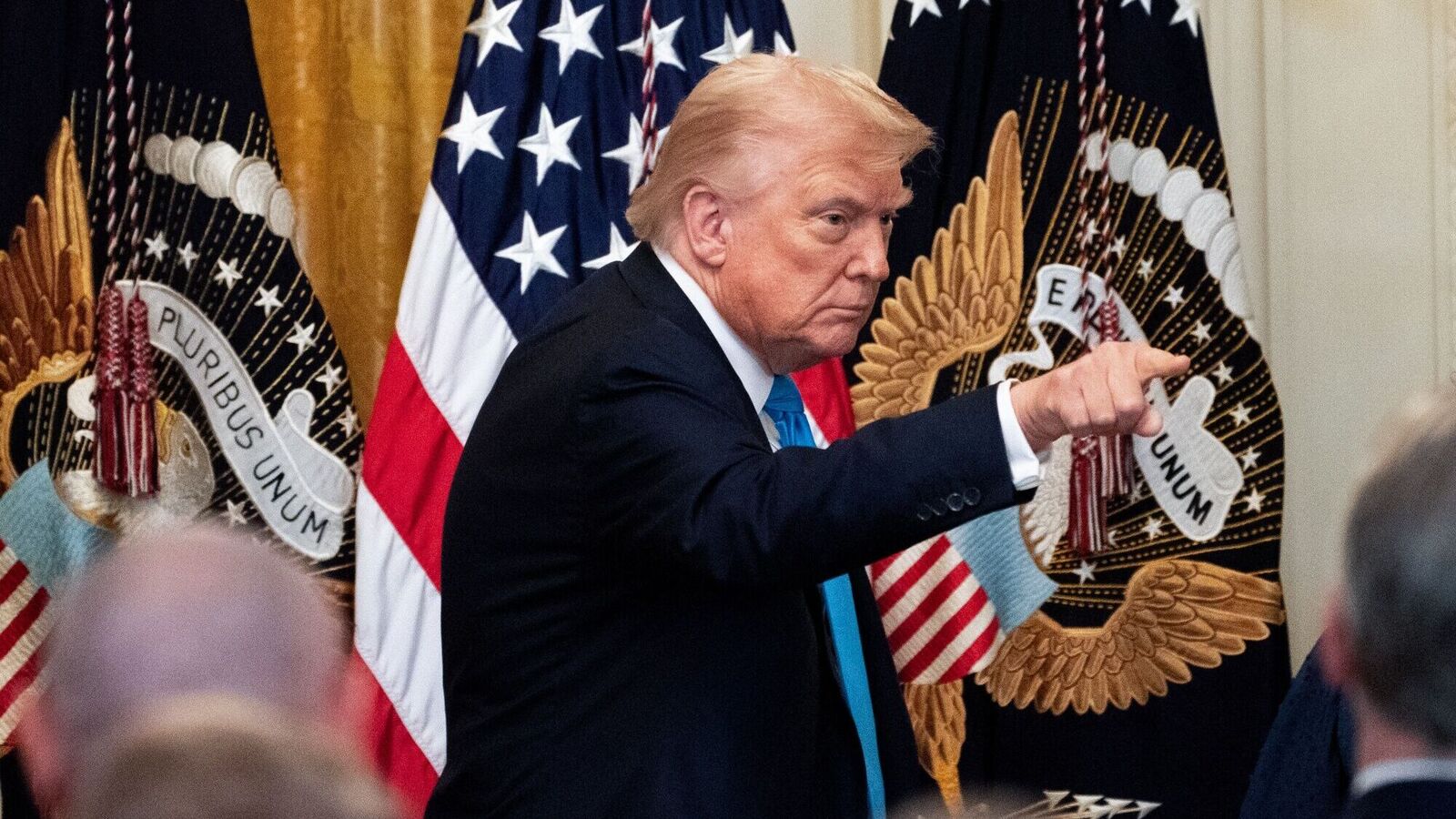
US President Donald Trump during a "Making Health Technology Great Again" event in the East Room of the White House in Washington, DC, US, on Wednesday, July 30, 2025. Leading US technology companies, including Amazon.com Inc., Anthropic, Apple Inc., Alphabet Inc.'s Google and OpenAI Inc., have pledged to work with health systems and the Trump administration to make the nation's fragmented medical data more useful for patients and providers. Photographer: Allison Robbert/Bloomberg
US President Donald Trump has announced extensive alterations to the nation’s tariff regime, which includes the introduction of up to 100 per cent tariffs on certain branded pharmaceutical imports. This initiative also revises tariffs on steel, aluminium, and copper products. These changes aim to compensate for the loss of revenue following the rejection of widespread global tariffs by the Supreme Court a year earlier.
The administration’s objective is to recover lost tariff income, though these measures have faced opposition from various business organisations, particularly given the increasing energy costs associated with the ongoing conflict in Iran.
In a declaration derived from a national security investigation into pharmaceutical imports, foreign makers of patented medications are now required to either lower prescription prices or shift production to the United States. Companies fulfilling these conditions entirely can avoid tariffs, whereas those that only partially relocate their manufacturing will incur a 20 per cent duty. Firms failing to comply will be subjected to tariffs potentially reaching 100 per cent.
Specifics of Pharmaceutical Tariffs
The new tariff framework will not be uniformly applied across all nations. Trade agreements with regions such as the European Union, Japan, South Korea, and Switzerland will limit branded drug tariffs to a maximum of 15 per cent. In addition, a recent agreement between the US and Britain will ensure no tariffs on British-manufactured pharmaceuticals for a minimum of three years, conditional upon an expanded production presence in the US.
Large pharmaceutical corporations have been granted a period of 120 days to adapt to the revised policies, while smaller producers have 180 days before facing the highest tariff rates. This timeframe aims to facilitate a smoother transition for the industry.
The ramifications of these tariffs have brought about significant debate. Industry representatives have expressed concerns regarding the potential impact on healthcare costs, as well as the broader implications these tariffs may have on the pharmaceutical market.
Revisions to Metal Tariffs
In conjunction with changes to pharmaceutical tariffs, President Trump also announced modifications to the tariffs associated with metals. Duties on several derivative products comprised of steel, aluminium, and copper have been reduced to 25 per cent. Moreover, tariffs on items containing minimal metal content will be eliminated altogether.
A 50 per cent duty, however, remains applicable on the essential commodity imports of these metals. Furthermore, the calculations for these tariffs have shifted from the declared import value to the US sales price of metals, a decision officials state will help mitigate under-reporting issues.
Products with less than 15 per cent metal content by weight will now be excluded from these tariffs. Notably, tariffs on certain metal-intensive industrial and power-grid equipment will be decreased to 15 per cent from 50 per cent through 2027, providing support for further industrial and data centre development.
Industry Reactions to Tariff Changes
These tariff modifications represent a departure from the “Liberation Day” tariffs introduced under the International Emergency Economic Powers Act (IEEPA) last year, which had initiated global retaliatory measures and legal disputes. Following a Supreme Court ruling that declared those tariffs illegal, plans are now in motion to refund approximately Rs 1.3 lakh crore that was collected during that timeframe.
US Trade Representative Jamieson Greer has characterised the broader tariff strategy as a necessary “reset button” for international trade, asserting its role in promoting domestic manufacturing and eliciting concessions from global trading partners. However, concerns persist within the industry, particularly from the US Chamber of Commerce, which cautions that the new pharmaceutical tariffs could lead to increased healthcare costs.
The construction, manufacturing, and energy sectors are already facing considerable input costs, with industry leaders worried about the additional strain resultant from these changes. Conversely, representatives from the steel industry have endorsed the revised strategies, claiming they enhance support for domestic production without creating disruptions to overall economic objectives.
Long or Short, get news the way you like. No ads. No redirections. Download Newspin and Stay Alert, The CSR Journal Mobile app, for fast, crisp, clean updates!
The Delhi government has announced the establishment of Societies for Prevention of Cruelty to Animals (SPCA) committees in all thirteen districts of the capital....
Buying diamonds has traditionally been associated with affluence and luxury, yet their market value has changed significantly over the years. Recent statistics indicate that...
Xiaomi recently introduced the Xiaomi 17 Ultra, its flagship smartphone with a focus on advanced photography. This device showcases a sophisticated triple rear camera...