


Crooked Forest Mystery: Poland’s 400 Bent Pines May Be Man-Made for Industry
The CSR Journal Magazine

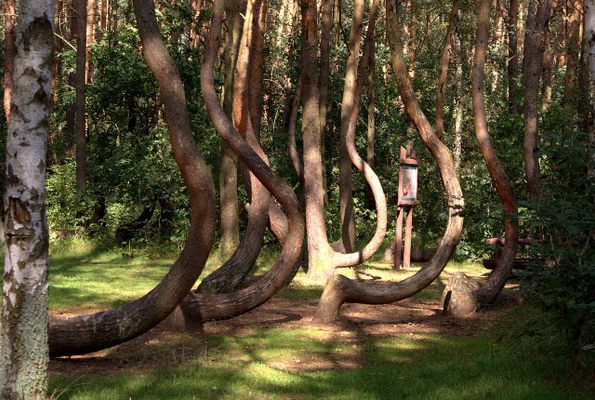
Located in northwestern Poland, the Crooked Forest (Krzywy Las) features approximately 400 Scots pines (Pinus sylvestris) that exhibit a striking and unusual growth pattern. These trees, planted in the early 1930s, are distinct due to their sharp 90-degree bends at the base, all oriented towards the north. While many trees curve back upwards, the uniformity of this peculiar formation has sparked intrigue and speculation about its origin.

Folklore vs. Scientific Inquiry

Local legends attribute the trees’ unique shapes to natural phenomena such as severe snowstorms or the movements of tanks during World War II. However, both the Gryfino Forest District and researchers from the University of Pennsylvania suggest that human involvement is the more likely explanation for the trees’ unusual curvature. A prevailing scientific theory proposes that local foresters may have intentionally manipulated the saplings to create timber with a natural curve, possibly for uses in shipbuilding or furniture making.

The Trees’ Intentional Design

The systematic bending of the trees necessitated human intervention. According to the Gryfino Forest District, if natural forces were responsible for the curvature, one would expect to see irregular bends in various directions. Instead, all 400 trees exhibit a consistent northward alignment, suggesting deliberate mechanical manipulation. This practice likely involved holding down the saplings with stakes or weights for several years, causing them to grow horizontally before curving upwards, as confirmed by analyses from the University of Pennsylvania’s Russian and East European Studies center.

Historical Context and Abandonment

The predominant theory regarding the Crooked Forest indicates that the trees were shaped intentionally for the needs of industrial use. Before synthetic alternatives became prevalent, foresters would manipulate tree growth to yield predetermined shapes suited to specific applications, including the making of ship ribs and curved furniture like rocking chairs. However, with the onset of World War II and the invasion of Poland in 1939, the project was abandoned, and the local populace who may have held this artisanal knowledge faced displacement or death, leading to a loss of understanding about these manipulated trees.

Disproving Urban Legends

A common urban myth claims the bends resulted from damage inflicted by World War II tanks. Nevertheless, the Gryfino Forest District has pointed out that there is no evidence of bark scarring or any mechanical damage that would support such an explanation. Additionally, the density of the trees implies that it is unlikely tanks could have caused such alignment while leaving all 400 trees unharmed. Similarly, while heavy snow can bend trees, it typically causes erratic corkscrew patterns rather than the uniformly bent shapes witnessed in the Crooked Forest.

The Biology Behind the Curvature

Researchers are exploring how these Scots pines utilize gravitropism, a growth response to gravity. During their period of imposed suppression, the trees would produce compression wood on the lower sides of their trunks. After the constraints were removed, they would reorient vertically, showcasing their adaptability. Currently, the Crooked Forest is designated as a protected natural monument, and the Gryfino Forest District has initiated efforts to create a nearby reforestation project aimed at studying this fascinating phenomenon further.

Long or Short, get news the way you like. No ads. No redirections. Download Newspin and Stay Alert, The CSR Journal Mobile app, for fast, crisp, clean updates!

App Store –  https://apps.apple.com/in/app/newspin/id6746449540 

Google Play Store – https://play.google.com/store/apps/details?id=com.inventifweb.newspin&pcampaignid=web_share

Latest News

Popular Videos
