


app-store-logo
play-store-logo
March 16, 2026

Climate Change Causes Lengthening of Days Due to Slower Earth Rotation
The CSR Journal Magazine

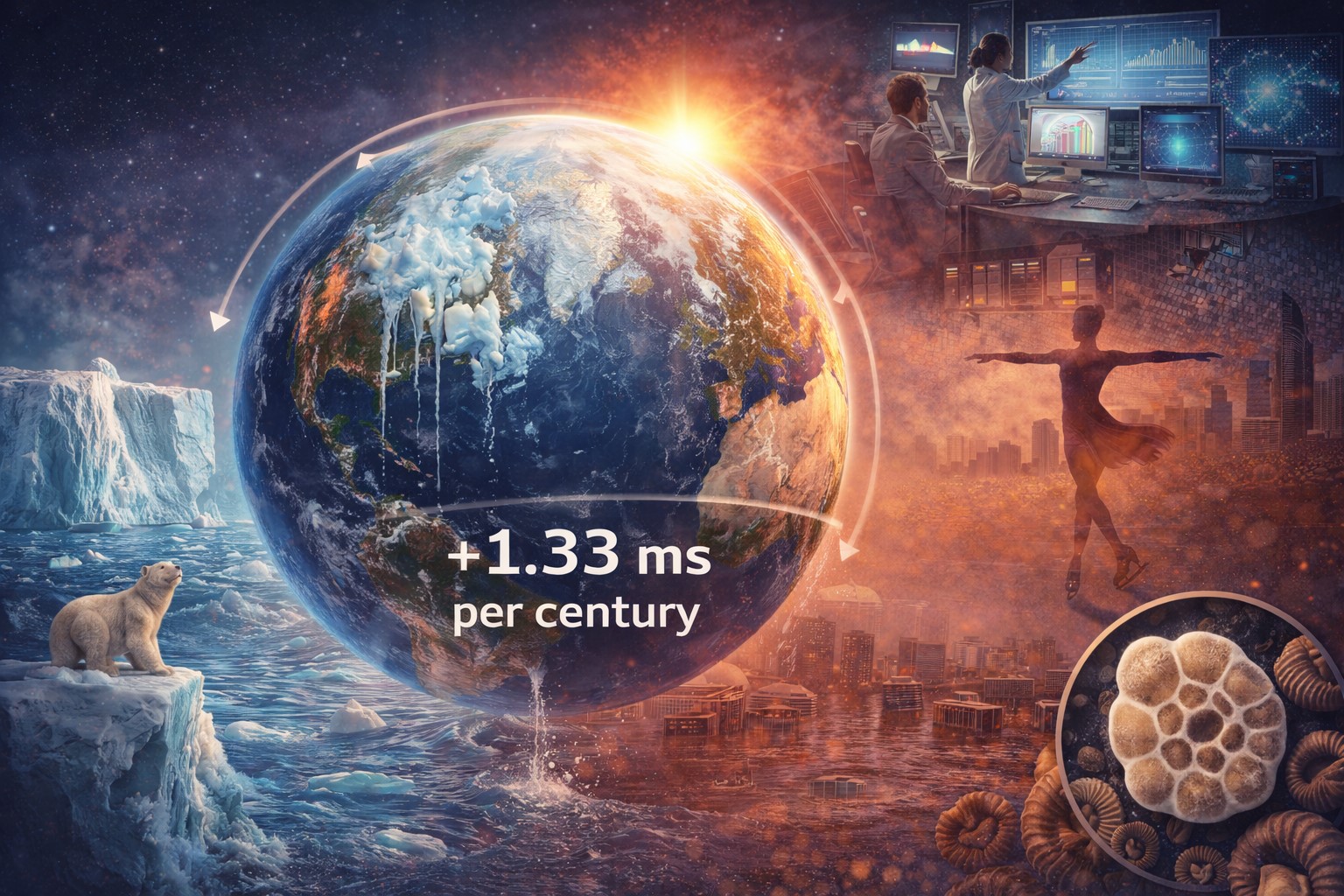
Recent research indicates that Earth’s days are gradually becoming longer, a phenomenon linked to the effects of climate change. Specifically, rising sea levels from melting glaciers and polar ice sheets are slowing down the planet’s rotation, resulting in an approximate increase of 1.33 milliseconds in the length of a day every century. Conducted by teams from the University of Vienna and ETH Zurich, this study reveals that such a rate of change has not been observed for the last 3.6 million years.

Understanding the Mechanism Behind Longer Days

The process by which melting ice affects the planet’s rotation is more straightforward than it may seem. As polar and mountain ice melts in the current century, the redistribution of mass across the Earth’s surface leads to a deceleration of its rotation, thereby lengthening the day. This can be likened to a figure skater who slows their spin when they extend their arms outward. Earth’s rotation is not uniform and can be influenced by various factors, including the gravitational effects of the Moon, internal movements within the planet, and atmospheric variations. However, what raises concerns is that human-induced climate change has now emerged as a significant factor in these rotational changes.

Research Methodology and Findings

To explore the changes in Earth’s rotation over millions of years, the researchers utilized fossil remains of a microscopic marine organism known as benthic foraminifera. The chemical makeup of these fossils provides insights into historical sea-level changes, allowing scientists to mathematically deduce corresponding variations in day length. The study also incorporated a deep-learning model to address the considerable uncertainties present in ancient climatic data.

Consequences of Slight Alterations in Day Length

While the changes in day length may seem negligible from a human perspective, they can have significant repercussions. Minor adjustments in Earth’s rotation can create challenges in various fields, including space navigation, GPS accuracy, atomic clock synchronization, and satellite monitoring. According to Benedikt Soja, the lead author of the study and a geophysicist at ETH Zurich, by the end of this century, climate change is projected to exert a greater influence on the length of a day compared to the gravitational pull of the Moon. “The current rapid increase in day length can thus be attributed primarily to human influences,” Soja remarked. These findings further illustrate the complex interplay of factors contributing to climate change.

Interconnectedness of Climate Systems

The implications of this research extend beyond the length of days. The same ice melt contributing to rising sea levels and altering weather patterns is now also affecting the Earth’s rotational dynamics. This serves as a poignant reminder of how intricately linked the various aspects of the climate crisis are. The ongoing rise in sea levels threatens habitats and communities globally, while simultaneously impacting fundamental aspects of our world, such as timekeeping and navigation systems. The changes in Earth’s rotation highlight the far-reaching effects of climate change, demonstrating the need for urgent action.

Long or Short, get news the way you like. No ads. No redirections. Download Newspin and Stay Alert, The CSR Journal Mobile app, for fast, crisp, clean updates!

App Store –  https://apps.apple.com/in/app/newspin/id6746449540 

Google Play Store – https://play.google.com/store/apps/details?id=com.inventifweb.newspin&pcampaignid=web_share

Latest News

Popular Videos
