app-store-logo
play-store-logo
March 9, 2026

Bullied for My English, Until the Street Walked With Me to TEDx
The CSR Journal Magazine

There is a particular species of cruelty that schoolteachers in small Indian cities practised in the 1990s with an almost artistic commitment. It was not the cruelty of monsters. It was something far more banal and therefore far more damaging: the cruelty of people who believed they were helping.

My teacher in Bhayander — a Catholic woman who wore starched cotton saris and carried a steel-tipped pointer like a sceptre — was one such artisan of shame.

I was perhaps 9 years old. The classroom smelled of chalk dust and hair oil and that particular anxiety that Indian children learn to metabolise the way other animals metabolise oxygen.

She called on me to read aloud from the textbook. The word was “entrepreneur.” A French word, borrowed by the English, then borrowed again by us, now sitting in the middle of a Rajasthani boy’s mouth like a stone he could not spit out and could not swallow.

My jaw moved. Something emerged. It was not the word. “Jaimine, speak up! Can’t you even pronounce entrepreneur properly?”

60 faces turned. The laughter, when it came, was not the theatrical laughter of cinema bullies. Itwas quieter and therefore worse — the suppressed, delighted snort of children who are grateful the catastrophe has happened to someone else today. I stood there and understood, with the specific clarity that only humiliation produces, that language was not a tool I was permitted to use in public.

This understanding was then reinforced at home, across dinner tables, at Diwali gatherings, in the casual drive-by verdicts that extended families deliver with the tenderness of people who consider honesty a form of love.

“Beta, stick to numbers,” an aunt said at a family gathering, pressing a ladoo into my hand as consolation for the life she was foreclosing. “Words aren’t for you.”

And there was the cousin — older, larger, confident in the way that boys who have never been publicly mocked are confident — who locked me in a room during one Diwali and made me recite a poem over and over until I wept. He told people afterward that he was helping me practise. Perhaps he believed it. The road to a child’s psychological wreckage is paved, overwhelmingly, with good intentions.
The result was entirely predictable. I retreated into the interior. Books, numbers, ledgers, theory.

The safe cartography of ideas that did not require me to open my mouth and perform. I became a good student in the way that children who are afraid of the world become good students — obsessively, compensatory, as though academic achievement could purchase the silence of everyone who had ever laughed. In a sense it worked. I became “Dr. Jaimine Vaishnav”. eventually. I got a classroom of my own.

What I did not get — what I carried instead, lodged in my sternum like a splinter — was the permission to speak.

Fast-forward 3 decades to a late-night in mid-2025. I am sitting at my desk in Mumbai with the particular exhaustion of a man who has spent the day teaching MBA students about entrepreneurship from a textbook written by people who have, in the main, never met an entrepreneur. My inbox contains approximately 400 hundred unread emails. I am scrolling through them with the mechanical despair of a man searching for meaning in a landfill.

One email stops me.

TEDx Global Idea Search. Submissions invited.

I want to be honest about what happened next, because the honest version is considerably less heroic than any version I might construct for the purposes of narrative satisfaction. I did not have an epiphany. I did not feel the stirring of destiny. What I felt was the mild, slightly manic recklessness of a man on the 4th hour of an insomniac night who has had 2 cups of tea too many and whose critical faculties are operating at approximately 60 percent. I typed out an application in something close to a fugue state. The subject I proposed was India’s street vendors.

I sent it.

Then I closed the laptop and went to sleep and forgot about it entirely.

The selection letter arrived 6 weeks later. I stared at it for several minutes. Then I sat back down and stared at it some more. Then, with the specific nausea of a man who has just discovered that the universe has taken him at his word, I understood what I had agreed to.

I had agreed to stand on a stage in Mumbai — the very city in which the original sin had been committed, in which the steel-tipped pointer had extracted its toll, in which 60 children had snorted at the word I could not say — and speak. In public. On camera. About ideas I genuinely cared about, which meant ideas I could genuinely fail to articulate, which meant that the failure, if it came, would be real.
The irony was not lost on me. The irony was, in fact, approximately the size of a freight container.

Let me tell you what I actually know about street vendors, because this story — my
psychological autobiography — is embedded inside a larger story that matters considerably more than my therapy.

India has approximately 10,00,000 street vendors. Yeah? The number is so large it becomes abstract immediately, the way large numbers always do.

So let me try it differently: ten million people who wake before dawn, load their carts, and occupy the margins of cities that officially do not want them there, to sell things that the same cities cannot function without. They sell the idli that the software engineer eats at 7 a.m. before his Ola. They sell the chai that the municipal officer drinks while processing the paperwork that will eventually be used to fine the vendor for selling the chai. The circularity is perfect. The irony is structural.

The Periodic Labour Force Survey (2022–23) tells us: over 110 million Indians work in unincorporated enterprises. Nearly 10 million are street vendors. The sector generates roughly ₹90,000 crores annually. Street vending accounts for 14 percent of urban employment.

And yet — and this is where the numbers acquire moral weight — the system extracts nearly ₹4,000 crores annually in bribes. Four thousand crore rupees; the amount so fair that it can sponsor whole of Pakistan for a weekend trip in Dubai.

Vanished. Into the pockets of municipal inspectors and police constables and sundry functionaries of the state, extracted from people who are already operating on margins so thin they would make a Harvard MBA weep.

I have spent years researching this. I have sat in the pre-dawn markets and drunk bad chai and listened to these people talk about their lives with the unsentimental practicality that survival produces. And what I have found, consistently, beneath the statistics and the policy failures and the daily extortion, is something that business schools spend a great deal of money trying to teach and largely fail to teach: genuine entrepreneurial intelligence.

Consider Anoj. He started a sandwich stall near a railway station in Mumbai with ₹20,000 borrowed from his mother. He had no business plan, no market research, no mentor. What he had was proximity to hungry commuters and the ability to read their patterns with a precision that would embarrass a data scientist. Within 3 years, his stall had spawned 2 more, managed by cousins. He had built a supply chain, negotiated terms with two vegetable suppliers, and developed a pricing model that adjusted for the velocity of the crowd at different hours of the day. He had done all of this without ever using the word “scaling.”

Then there is Arti, a flower vendor whose stall is demolished twice a year by municipal authorities with the mechanical regularity of the monsoon. She rebuilds. Every time. I asked her once — this was late evening; she was arranging wilted marigolds into garlands with the focused economy of motion that comes from doing something thousands of times — I asked her how she kept going.

“Doctor saab,” she said, without looking up from the marigolds, “what else can I do? This is my fight.”

I have a PhD in Informal Economy between India and China via Sikkim state. I have read Porter and Drucker and Prahalad and approximately a 300 case studies from institutions that charge more per semester than Arti will earn this decade. I have never encountered a more precise particulation of the entrepreneurial condition.

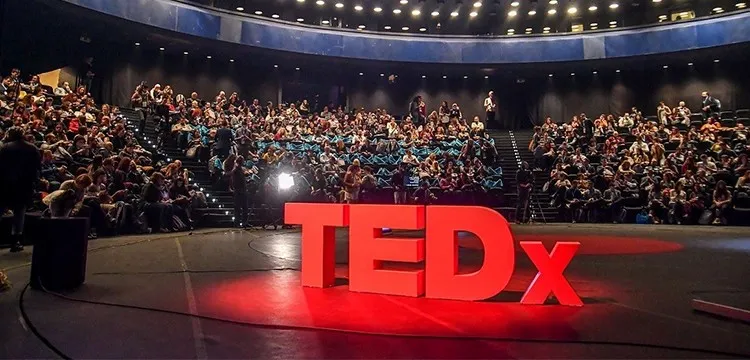
TEDx Global Idea Search in Mumbai is held in a posh auditorium in South Bombay that smells of fresh paint and ambition. The red dot on the stage is smaller than it looks in photographs. I stood backstage and listened to my heartbeat and thought, with the precise involuntary clarity that terror produces, about the classroom. The pointer. The 60 faces. The word I could not say.

I had rehearsed it 210 times. Thanks to curators and mentors like Oshin and Hemali, too. I know the number because I kept a log, partly out of the obsessive anxiety of a man who has spent 30 years avoiding precisely this moment, and partly because logging things is what academics do when they are frightened and need to convert fear into data.

I walked out. The light hit me. The audience was perhaps 500 people, which is a number that sounds manageable until you are standing in front of them with a microphone. Kelly Stoetzel introduced me. I heard my name and my title and then a silence that seemed to last considerably longer than it actually did.

I spoke.

6 minutes. The statistics. The stories of Anoj and Arti and others.

The word “encroachers.” It is the word municipal authorities use for vendors. It is a word I find morally repugnant because it treats people who are exercising a survival strategy as a spatial nuisance. It is also, apparently, a word that still lives in my mouth like a ghost of the original wound. My jaw moved. There was a pause.

The audience leaned forward.

Not to laugh. To listen.

I have thought about that moment many times since. There is something in the human capacity to lean toward rather than away from a speaker’s difficulty that I cannot entirely account for with any theory I know. It is not pity exactly. It is something closer to recognition — the audience knowing, in some pre-verbal way, that what they are witnessing is real and not performance. The stutter, in that moment, was not a failure of the talk. It was the talk’s most honest sentence.

I finished. Applause. The specific, generous, sustained applause of an audience that has been given something they did not know they needed.

The boy who could not say “entrepreneur” stood on a stage in the city where the crime had been committed and spoke for 6 minutes about ten million people who run businesses without MBAs, and the audience leaned in.

Then, I should tell you about the Baroda Municipal Commissioner.

He was sitting in the front row of the TEDxPWSYouth event hosted by Rekhaa Shah, Principal of Poddar World School, Vadodara, which I discovered approximately 2 minutes before I went on, and which produced in me a sensation that I can only describe as the intellectual equivalent of stepping onto a diving board and discovering that the pool has been drained.

I considered, briefly, softening the section about the ₹4,000 crore bribe economy. I considered euphemism. I considered the kind of tactful circumlocution that allows everyone in a room to understand that something corrupt is happening without anyone being required to say so directly, which is a social technology Indians have developed over centuries and deployed with genuine elegance.

I said it anyway.

“₹4,000 crore disappears into the shadows every year,” I said, and watched the Commissioner’s polite smile undergo a complex molecular rearrangement. He did not stop smiling. He was too professional for that. But the smile became a different kind of smile — the smile of a man who is recalibrating his understanding of the afternoon’s agenda.

Afterward, in the green room, he found me.

“Bold talk,” he said.

We ended up talking for 40 minutes about vending zones and policy implementation and the gap between what the Street Vendors Act says and what actually happens when a constable approaches a vendor’s cart. It was, genuinely, one of the better policy conversations I have had.

It would not have happened if I had been tactful.

This is something I have learned, in the specific classroom of public speaking: truth, delivered without cruelty, tends to create more productive conversations than diplomacy. The polished version of a difficult thing allows everyone to nod and agree and change nothing. The blunt version forces people to respond, which is the necessary precondition for anything actually changing.

Also,

I want to talk about pedagogy, because pedagogy is where this story gets genuinely strange.

I began, a few years ago, sending them to intern with street vendors for 3 weeks. Not to study vendors from above, clipboard in hand, with the benevolent condescension of the formally educated observing the informally clever. To work for them. To follow instructions. To learn.

The results were consistently disorienting for everyone involved.

One student — a young woman named Priya, sharp, ambitious, destined for a consulting firm — came back from three weeks with a flower vendor and sat in my office and told me that she had spent the first week being comprehensively useless. The vendor, a woman named Savita, knew things about the temporal rhythms of her customers, the microeconomics of wilting, the emotional weight of different flowers for different occasions, that Priya had no framework to process.

“Sir,” Priya told me, with the slightly stunned affect of someone who has had a foundational assumption overturned, “that woman understands pricing better than any Harvard case study I’ve read.”

This is not a sentimental observation about the wisdom of the poor. It is an epistemological observation about where knowledge lives. The formal education system has a persistent and largely unexamined tendency to treat knowledge that has not been certified as less than knowledge that has. The MBA teaches you to build a pricing model. The flower vendor has already built one, iteratively, over years, through direct contact with reality. The model she has built is, in most practical senses, better.

An IIM Ahmedabad study from 2022 found that nearly 60% of vendor sales come from repeat relationships. The informal economy runs on trust. This is not sentimentality. This is strategy. Capital—emotional, relational, reputational—that vendors accumulate over years is precisely what keeps them solvent when the municipal authorities come to demolish everything else.

The Reserve Bank of India reported in 2024 that nearly 92% of micro-entrepreneurs rely entirely on self-financing. No venture capital. No angel investors. No seed rounds. Just savings and relationship capital and the willingness to absorb risk that would make a Silicon Valley pitch deck quiver. The informal economy’s estimated value is ₹80,000 crores annually, roughly 2.5% of urban economic activity. This is the GDP of a small European country, built on chai and poha and marigolds and the accumulated trust of repeat customers.

I want to be honest about the mechanics of change, because there is a version of this story that implies that standing on a stage cured me, that the applause dissolved the old wound, that one moment of triumph reversed three decades of constructed silence. That would be a satisfying story. It would also be false.

What actually happened was slower and stranger and more work than any single moment could contain.

Dale Carnegie’s “How to Win Friends and Influence People” is a book that serious people are supposed to condescend to, because it is popular and because its title is aggressively practical and because it was written in 1936 and because genuine intellectual sophistication requires a performative distaste for things that actually work. I read it and was embarrassed to be reading it and then found, buried in its relentlessly cheerful prose, something genuinely useful: warmth matters more than wit. The speaker who makes an audience feel seen will be forgiven for imperfect sentences in a way that the brilliant speaker who makes an audience feel inadequate will not.

Chris Anderson’s talks taught me something about structure that I had not understood despite years of giving academic lectures: a talk is not a lecture. A lecture distributes information. A talk communicates an idea, singular, and everything in it should serve that idea or be cut. The discipline this requires is painful for academics, who are professionally rewarded for comprehensiveness. I am constitutionally inclined to say everything I know about a subject. The constraint of 6 minutes, applied ruthlessly, was genuinely useful.

Carmine Gallo’s “Talk Like TED” gave me permission to use stories instead of apologising for them. In academic culture, the anecdote is always slightly suspect — too particular, too uncontrolled, resistant to generalisation. But Gallo’s central insight — that stories are not illustrations of ideas, they are the medium through which ideas actually travel between minds — gave me a different relationship with Anoj and Arti and Salma. They were not examples. They were the argument.

Julian Treasure’s How to Speak So That People Want to Listen was the strangest of the four, because it made me pay attention to my voice as a physical instrument rather than an unfortunate defect. I have spent thirty years in an adversarial relationship with my voice. The stutter felt like a traitor, a part of me that reliably chose the worst possible moment to malfunction. Treasure’s framing — that voice is a tool, that it can be trained, that its idiosyncrasies can be worked with rather than against — did not eliminate the stutter. But it changed my relationship to it. The pause before the difficult word became, eventually, a feature rather than a failure. A moment of weight.

None of these books gave me a voice. What they gave me was a framework for the voice I already had.

For your perusal,

The International Labour Organization estimates that 60% of the world’s workforce operates in the informal sector. In India, the proportion is higher. Street vending alone — that subset of the informal economy that is most visible and most harassed — represents one of the most accessible forms of entrepreneurship on the planet. In many cities, you can enter it with ₹5,000 of startup capital. No registration, no certification, no 5-year business plan. Just a product, a location, and a willingness to show up.

And yet the policy apparatus treats it as a problem. Cities want to be smart and clean and modern, which is a set of aspirations that tends, in practice, to mean hostile to the messy, adaptive, human-scale commerce that happens on pavements. The Street Vendors Act, 2014, was passed after decades of advocacy and is still only partially implemented in most cities.

A Greenpeace report from 2024 found that 80% of vendors experienced income losses during extreme heat events — a finding that sits at the intersection of climate justice and economic vulnerability in a way that should command serious policy attention and largely does not.

The informal economy is resilient. But resilience is not the same as justice. The fact that people survive despite a system that extracts from them and occasionally demolishes their livelihoods is not an argument for that system. It is an argument against it.

What would it look like to take seriously what these vendors know? To design vending zones that are actually functional rather than theoretically permitted. To build micro-loan products that match the cash-flow realities of pavement businesses rather than the risk models of banks.

To send students — not just mine, but systematically — to learn from people who run businesses under conditions of genuine uncertainty, with genuine stakes, every day.

To treat the informal economy not as a transitional phase on the way to formalisation but as a permanent and legitimate feature of Indian economic life that deserves policy made in its image.

These are not radical propositions. They are competent ones.

After the talk in Mumbai, I walked home a different way than usual. Longer, through a market I know but don’t often stop in. It was evening, the particular blue-grey hour when the city’s colours deepen and the smell of frying things from a hundred stalls creates something that is not quite food and not quite air but is entirely Mumbai.

I passed a tea stall. The vendor — young, perhaps 22, with the focused efficiency of someone for whom every minute of daylight is money — had polished his steel cart to a brightness that seemed almost aggressive in the fading light. I caught my reflection in it.

I stopped.

This is not a metaphor. Or rather, it became one, but it was first a literal thing: a man in his forties, slightly dishevelled from a day of public speaking, seeing himself in the polished steel of a young man’s cart and finding, for perhaps the first time, that he did not need to look away.

The boy from the classroom in Bhayander, who could not say the word and stood while 60 faces turned, who was told by an aunt with a ladoo in her hand that words were not for him, who spent thirty years building an interior fortress of books and theories and data — that boy had stood on stages in 2 cities and spoken about ten million people who are told, by the architecture of the system itself, that the city is not for them, and who show up anyway, every morning, before the light.

I thought about the bullies. The teacher with her pointer. The cousin with his locked room. The aunt with her verdict. I want to be honest about this too: I do not think forgiveness is the right word for what I feel toward them.

Forgiveness implies that what they did constituted an injury they understood themselves to be inflicting, and I don’t believe that’s true in most cases. What I feel is something closer to comprehension. They were operating with the tools they had in the culture they were in, and those tools produced, in me, a particular wound, and that wound, ultimately, gave me something to say.

The mockery sharpened the resolve. The foreclosure created the hunger. The locked room built the lungs.

I don’t recommend this as a pedagogical method.

But I will say: the scars turned out to be the material.

If you are reading this from inside a particular kind of silence — the silence of the child who has been told, explicitly or implicitly, that their voice does not fit the space they are in — then I want to tell you something that I wish someone had told me in that classroom.

The idea does not need perfect grammar. It needs truth.

The stutter, the accent, the cracked voice, the wrong register, the language that marks you as the outsider in the room you are trying to enter — none of these are disqualifications. They are, if you are patient with them, a form of authenticity that polished speakers spend their whole careers trying to manufacture and usually fail.

Apply anyway. Speak anyway. Send the email at 2 a.m. in the slightly manic recklessness of an insomniac who has had two cups of tea too many, and then go to sleep, and be surprised when the answer comes back.

The streets taught me this. Anoj taught me this. Arti among her marigolds taught me this. Salma at 6:30 am with her extra spoonful and her calibrated smile — she taught me this.

Ten million people build their livelihoods on pavements the city would prefer to keep empty. They are not waiting for permission. They are not waiting for the system to recognise them. They show up in the dark and they build and when the authorities come to demolish they rebuild.

Sometimes the microphone finds the truth.

Sometimes the truth is just showing up.

Views of the author are personal and do not necessarily represent the website’s views.

Dr. Jaimine Vaishnav is a faculty of geopolitics and world economy and other liberal arts subjects, a researcher with publications in SCI and ABDC journals, and an author of 6 books specializing in informal economies, mass media, and street entrepreneurship. With over a decade of experience as an academic and options trader, he is keen on bridging the grassroots business practices with global economic thought. His work emphasizes resilience, innovation, and human action in everyday human life. He can be contacted on jaiminism@hotmail.co.in for further communication.

Long or Short, get news the way you like. No ads. No redirections. Download Newspin and Stay Alert, The CSR Journal Mobile app, for fast, crisp, clean updates!

App Store – https://apps.apple.com/in/app/newspin/id6746449540

Google Play Store – https://play.google.com/store/apps/details?id=com.inventifweb.newspin&pcampaignid=web_share

Latest News

Popular Videos