


app-store-logo
play-store-logo
February 14, 2026

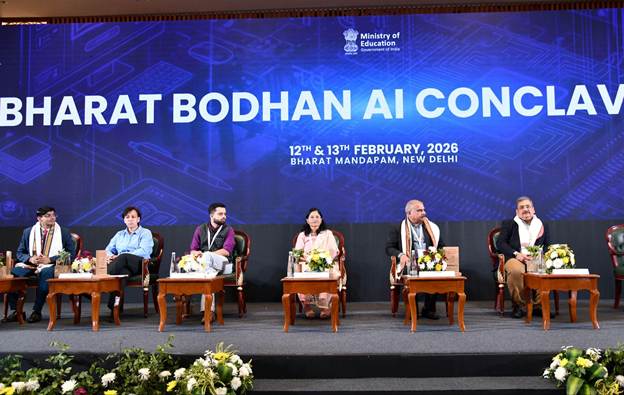
Bharat Bodhan AI Conclave 2026 Concludes, Emphasizing Responsible AI Transformation in Education

The CSR Journal Magazine

The Bharat Bodhan AI Conclave 2026, organized by the Ministry of Education, concluded in New Delhi, reinforcing a unified commitment to a responsible transition towards AI-driven approaches in India’s education sector. The event featured two significant sessions on its second day aimed at exploring innovative governance and multilingual AI frameworks. Moderated by Prof. Manindra Aggarwal from IIT Kanpur, the first session focused on governance platforms and scalable AI systems, highlighting the shift among states from a monitoring approach to intervention-based governance facilitated by AI-enhanced platforms. It was noted that integrated systems for students, teachers, and schools are beginning to replace traditional fragmented tools, promoting real-time decision-making. Discussions emphasized that expanding AI solutions across states requires ecosystem platforms rather than isolated implementations.

Multilingual AI and Teacher Empowerment Discussions Held

The second session examined the importance of multilingual AI, teacher empowerment, and practice-oriented learning. Moderated by Prof. Manoj Kumar Tiwari from IIM Mumbai, participants underlined that multilingual AI is crucial for achieving equitable adoption at a national level. The discourse revealed that AI should bolster teacher engagement and support contextual teaching methods rather than enforce standardized digital frameworks. Evidence presented during the session indicated that practice-based learning approaches enhance student engagement, with various states sharing successful models that integrate AI to support both teacher effectiveness and student learning.

Key Conclusions and Strategic Directions Outlined

Throughout the sessions, three main conclusions emerged: India possesses robust AI solutions applicable in education, yet a broader scale is necessary to benefit all learners; teacher support is pivotal for enhancing learning outcomes; and the next development phase will require a national orchestration platform to ensure coherence in efforts. Following the sessions, a debriefing was conducted featuring input from key education officials, including Sanjay Kumar, Secretary of School Education & Literacy, and Vineet Joshi, Secretary of Higher Education. They, along with academic leaders and startup founders specializing in AI for education, discussed insights from the prior sessions and emphasized the importance of collaboration across the education ecosystem.

Potential of AI in Tailoring Learning Experiences

Sanjay Kumar remarked on the progress made over the past two and a half days, highlighting the innovative efforts underway across various states and institutions aimed at integrating AI into educational frameworks. He recognized AI’s potential to simultaneously enhance scalability and personalization, offering tailored learning interventions designed to meet each child’s unique needs. Kumar stressed that equitable access is vital for these innovations, as they can lead to improved learning outcomes, increased inclusion, and greater empowerment for both teachers and students. In addition, he underscored the necessity of developing collaborative platforms to disseminate effective practices nationwide and called for sustained investments in research and development alongside robust institutional infrastructures.

Participation and Impact of the Conclave

Prof. V. Kamakoti from IIT Madras reiterated the importance of scaling, coordination, and ensuring interoperability of existing AI solutions in education. He highlighted that AI applications must promote inclusion and respect linguistic diversity while preventing divides among learners. The Bharat Bodhan AI Conclave 2026 attracted a diverse array of participants from the educational and technological sectors, recording over 3,100 registrations, nearly 2,000 students, more than 600 delegates, and around 120 exhibitors showcasing AI-driven innovations. The two-day event convened policymakers, state representatives, researchers, philanthropic groups, and ed-tech innovators to explore how artificial intelligence can facilitate transformative changes in school education, focusing on foundational literacy and numeracy, teacher effectiveness, governance, and multilingual inclusion in the Indian education landscape.

Long or Short, get news the way you like. No ads. No redirections. Download Newspin and Stay Alert, The CSR Journal Mobile app, for fast, crisp, clean updates!

Latest News

Popular Videos