


Astronauts Capture Significant Earthrise and Lunar Features During Artemis 2 Mission
The CSR Journal Magazine

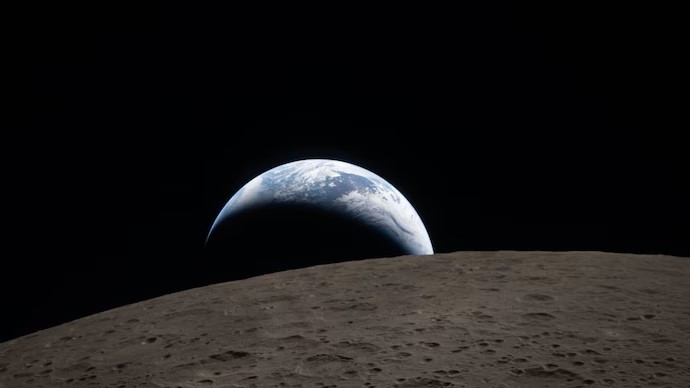
The Artemis 2 mission successfully saw four astronauts travel around the Moon, marking the first time humans have undertaken such a journey in over fifty years. During the mission, the crew observed an impressive ‘Earthrise’ at approximately 7:10 p.m. IST on April 7, when Earth reemerged from behind the lunar horizon following a 40-minute communication blackout. This remarkable moment, where Earth appeared against the stark backdrop of space, has been highlighted as a defining feature of the mission.

Astronauts Document Lunar Surfaces

During their extensive observation session lasting seven hours on April 7, the Artemis 2 crew captured an array of images showcasing both the near side and the unexplored far side of the Moon. Due to tidal locking, one side of the Moon consistently remains out of view from Earth. This allowed the crew to investigate previously unseen areas of the lunar landscape, providing a fresh perspective on its rugged terrain.

One notable image documented the lunar terminator, which is the distinct boundary separating the illuminated daytime surface from the dark night side. This shadow line produced long, dramatic shadows that enhanced the three-dimensional appearance of craters such as Birkhoff and Stebbins, allowing for greater visual interpretation of their depth and features.

The crew also captured images detailing the Orientale basin, a massive impact crater spanning approximately 965 kilometres in width. Created billions of years ago by a substantial celestial impact, the basin’s structure is characterised by concentric mountain rings, a result of the extensive forces experienced during its formation.

Newly Discovered Craters Proposed

Within the vicinity of the Orientale basin, the astronauts identified two smaller craters. They have suggested naming these craters Integrity, after the spacecraft itself, and Carroll, in honour of the late spouse of Commander Reid Wiseman. This gesture acknowledges personal connections while also contributing to lunar cartography.

Exploration of Solar Eclipse Experience

As part of their exploration, the Artemis 2 crew experienced a total solar eclipse while the Orion spacecraft moved behind the Moon. This event resulted in the temporary disappearance of the Sun for nearly one hour. The astronauts utilised specialized eclipse glasses to safely observe the solar corona, the uppermost layer of the Sun’s atmosphere, which is typically obscured during regular solar observations.

Witnessing the Earth suspended in the vastness of space amid the eclipse proved to be one of the most iconic moments of the mission. Such occurrences serve to deepen the understanding of celestial phenomena as perceived from unique vantage points beyond the confines of Earth.

The Artemis 2 mission is seen as a significant milestone in lunar exploration, leveraging advanced technology and international collaboration to gather invaluable data about the Moon and its surroundings. The photography and observations made during this mission could enhance future explorations and scientific objectives associated with lunar studies and beyond.

Long or Short, get news the way you like. No ads. No redirections. Download Newspin and Stay Alert, The CSR Journal Mobile app, for fast, crisp, clean updates!

App Store –  https://apps.apple.com/in/app/newspin/id6746449540 

Google Play Store – https://play.google.com/store/apps/details?id=com.inventifweb.newspin&pcampaignid=web_share

Latest News

Popular Videos
