


Ancient Indian Mathematician Discovered Fibonacci Pattern 300 Years Before Europe
The CSR Journal Magazine

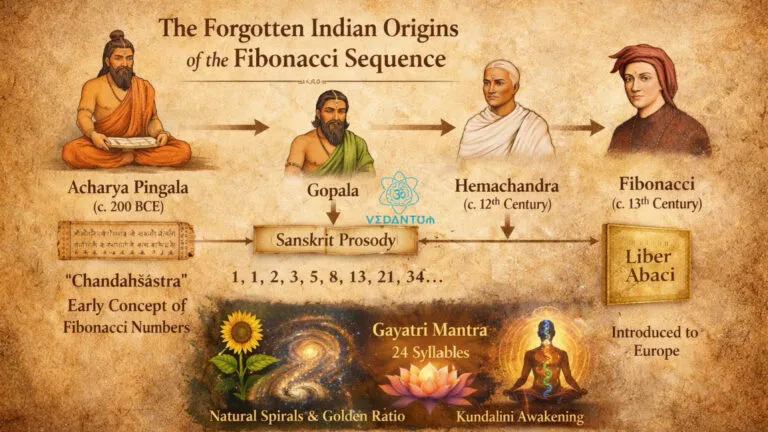
Fibonacci Day is celebrated on November 23, marking the recognition of the Fibonacci sequence, a mathematical pattern that has captivated scholars for centuries. This sequence, which starts with the numbers 1, 1, 2, 3, 5, 8, 13, 21, 34 and continues indefinitely, is taught in educational institutions globally. Interestingly, the roots of this sequence can be traced back to ancient Indian scholars who explored it long before it gained prominence in Europe through the work of Italian mathematician Leonardo Fibonacci.

The Fibonacci sequence is defined by a simple rule: each number is the sum of the two preceding numbers. Its applications are widespread, appearing in various fields such as nature, mathematics, computing, design, and finance. In nature, numerous examples exist, such as the arrangement of sunflower seeds, the spirals of pine cones, and the patterns found in pineapples, all of which are linked to Fibonacci numbers.

In the realms of architecture and design, the sequence’s relationship with the golden ratio is often employed to create aesthetically pleasing compositions. This mathematical concept has transcended cultural boundaries, revealing a rich history of mathematical exploration in ancient India.

Ancient Indian Contributions to the Fibonacci Sequence

One of the earliest documented contributions to the understanding of this sequence comes from Acharya Pingala, an ancient Indian scholar who examined Sanskrit poetic metres. In his seminal work, Chandahshastra, Pingala investigated the arrangement of short and long syllables to form various poetic rhythms. The study of these syllables laid the groundwork for mathematical exploration in India.

Sanskrit poetry employs two primary syllable types: Laghu, representing a short syllable, and Guru, which signifies a long syllable. Scholars began to analyse the combinations of these syllables within fixed rhythmic durations, leading to a deeper understanding of numerical patterns. This exploration became more pronounced with the work of Virahanka, a mathematician and prosodist who lived several centuries after Pingala. He articulated a rule for counting combinations of short and long syllables that produced a numerical pattern now recognised as the Fibonacci sequence.

Further advancements in this mathematical understanding were made by other Indian scholars, including Gopala and Acharya Hemachandra. Hemachandra, who lived between 1089 and 1172, described the sequence in the middle of the 12th century, predating Fibonacci’s influential work by several decades. This historical context underscores the significant contributions of Indian mathematicians to the development of this sequence.

The Popularisation of the Fibonacci Sequence in Europe

Leonardo Fibonacci introduced the sequence to the European mathematical community in his 1202 book, Liber Abaci. In this work, he illustrated the numerical pattern through a theoretical problem involving the reproduction of rabbits. By analysing how rabbit pairs would multiply under specific conditions, Fibonacci arrived at the sequence that is now widely recognised.

His contributions played a crucial role in popularising the Fibonacci sequence in Europe, leading to the association of his name with the pattern. However, historical research, including a notable 1985 paper by mathematician Parmanand Singh published in Historia Mathematica, has documented the earlier contributions of Indian scholars. While there is no definitive evidence that Fibonacci directly borrowed the sequence from these scholars, it is clear that the mathematical pattern was thoroughly explored in Indian scholarship prior to his work.

This narrative highlights the evolution of mathematical concepts across different civilisations, illustrating how knowledge can be developed through diverse and unexpected pathways. The Fibonacci sequence is not merely a mathematical curiosity; its history reveals the sophisticated mathematical insights that ancient Indian scholars discovered within the rhythms of their poetic traditions.

Long or Short, get news the way you like. No ads. No redirections. Download Newspin and Stay Alert, The CSR Journal Mobile app, for fast, crisp, clean updates!

App Store – https://apps.apple.com/in/app/newspin/id6746449540

Google Play Store – https://play.google.com/store/apps/details?id=com.inventifweb.newspin&pcampaignid=web_share

Latest News

Popular Videos
