


app-store-logo
play-store-logo
March 5, 2026

AI Transformation: Are Entry-Level Jobs Disappearing for Graduates?
The CSR Journal Magazine

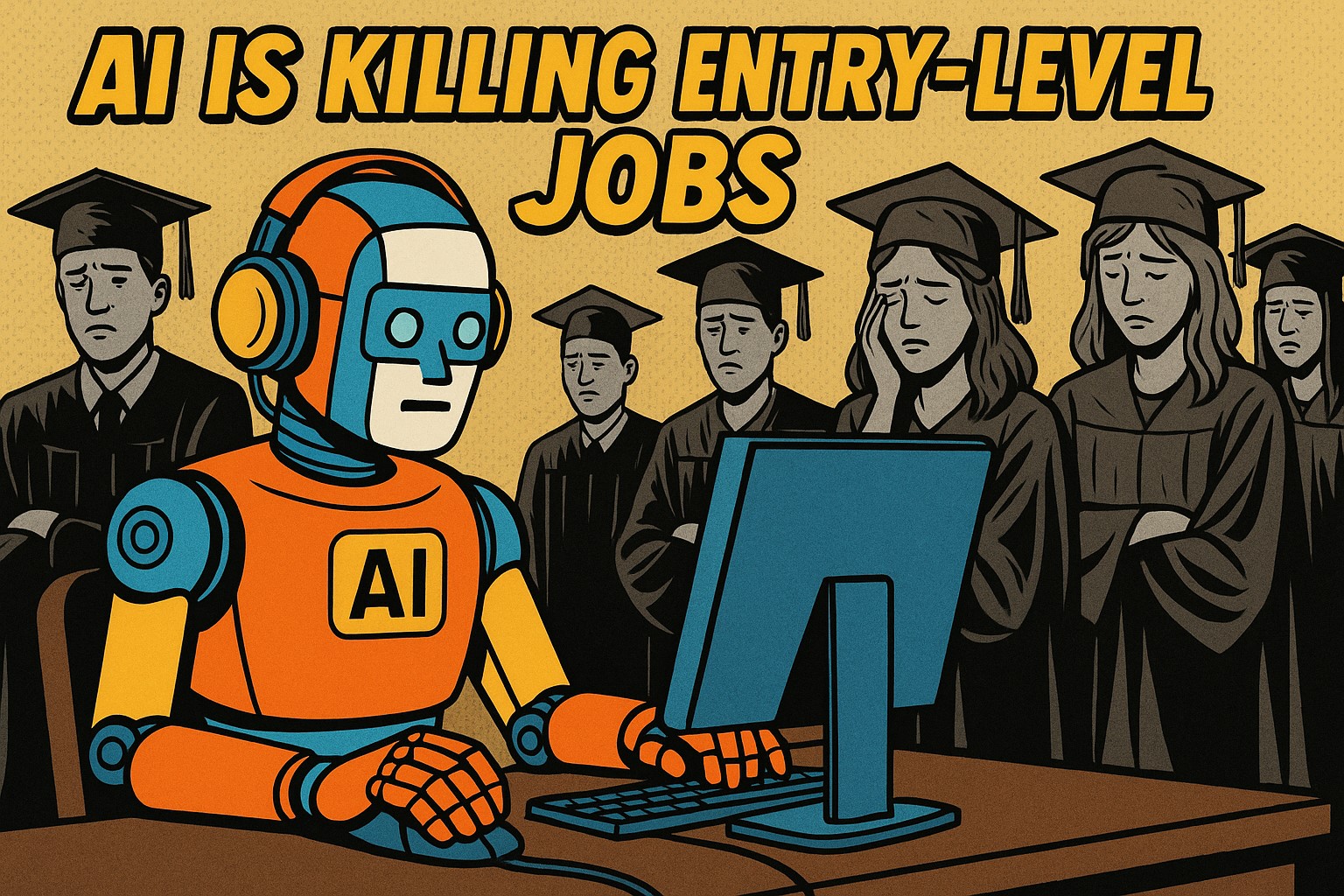
The job market for recent graduates is undergoing significant changes, with the pace of transformation outpacing many educational institutions’ abilities to adapt. Artificial intelligence (AI) is now a fundamental aspect of business operations, taking over tasks such as document analysis, report generation, contract review, and data processing. Activities once assigned to entry-level employees for their professional development are increasingly being automated. This has resulted not in immediate job losses but in a noticeable decline in entry-level job openings, indicating a structural shift in the organization of early-career work rather than merely a temporary slowdown.

Companies Accelerate AI Integration

Organizations are integrating AI technologies primarily for enhancing efficiency, minimizing errors, and reducing operational costs. According to the State of AI in Financial Services: 2026 Trends report by NVIDIA, a significant 73 percent of executives regard AI as vital for their business’s future, while 89 percent have reported improvements in revenue and cost reductions attributable to AI. From a corporate perspective, the rationale is clear: if technology can accomplish tasks more swiftly, accurately, and at a lower cost, it will be utilized, particularly during times of economic uncertainty. However, while this trend elevates operational efficiency, it may simultaneously diminish opportunities for new entrants to the workforce.

Impact on Indian Graduates

The implications of these changes are especially relevant for India, which produces millions of graduates annually. Traditionally, India’s workforce heavily depended on the bulk hiring of new graduates in sectors like IT services, consulting, and banking. Many entry-level roles involved repetitive tasks such as documentation and data processing—now increasingly automated by AI tools. Recent studies indicate that hiring practices are shifting; a report from the Indian Council for Research on International Economic Relations highlights that companies utilizing AI are moderating entry-level recruitment and prioritizing candidates with specialized skills in areas such as data analytics and digital technologies. In large markets like India, even minor decreases in entry-level hiring can significantly impact numerous young professionals attempting to enter the job market.

The Growing Need for Specialized Skills

As the demand for skills related to AI escalates, NASSCOM predicts that India’s AI talent pool may more than double to over 1.25 million professionals by 2027. The Naukri JobSpeak Index shows a 12 percent year-on-year increase in white-collar hiring, mainly driven by technology and AI roles. While emerging opportunities exist, they increasingly favor candidates equipped with specialized capabilities, thereby complicating entry for recent graduates.

Global Perspectives on Workforce Disruption

Various global analyses have highlighted the potential impact of AI on employment. A report by Goldman Sachs anticipates that approximately 300 million full-time jobs worldwide could be subjected to some form of automation. The World Economic Forum also indicates that although AI may create new positions, it could disrupt as many roles as it generates, particularly affecting white-collar and early-career jobs. These forecasts do not imply a total loss of jobs but rather a fundamental redesign of work responsibilities.

Experiential and Educational Challenges

One of the critical concerns arising from this transition is what experts term the “experience gap.” Historically, early-career roles served as foundational training for graduates, providing them with opportunities to develop professional judgment through routine tasks. However, as AI systems take over these basic responsibilities, new employees are increasingly tasked with evaluating AI-generated outputs and making decisions based on automated analysis. This shift necessitates experience that many young professionals may lack.

University Curriculum and Skills Development

The changes within the workforce raise significant questions for higher education institutions. If AI systems can efficiently generate reports and analyze data, the conventional emphasis on producing written assignments may need reevaluation. Educators advocate for curricula focusing on critical thinking, ethical decision-making, and understanding AI capabilities. Failure to adapt may exacerbate the gap between educational training and workplace demands.

Long-Term Implications for Talent Acquisition

While reducing entry-level positions may yield short-term efficiency for businesses, it poses long-term risks. Many organizations depend on early-career recruitment to nurture future leadership. A decline in graduates entering structured career paths today may hinder the development of robust leadership pipelines in the future. The expectations for fresh graduates are rising rapidly, emphasizing the need for them to collaborate effectively with AI tools. The challenge lies in ensuring advancements in technology do not inadvertently shut the door on professional opportunities for emerging talent.

Long or Short, get news the way you like. No ads. No redirections. Download Newspin and Stay Alert, The CSR Journal Mobile app, for fast, crisp, clean updates!

App Store –  https://apps.apple.com/in/app/newspin/id6746449540 

Google Play Store – https://play.google.com/store/apps/details?id=com.inventifweb.newspin&pcampaignid=web_share

Latest News

Popular Videos
