


Isro Successfully Conducts Gaganyaan Capsule Drop Test from Three Kilometres
The CSR Journal Magazine

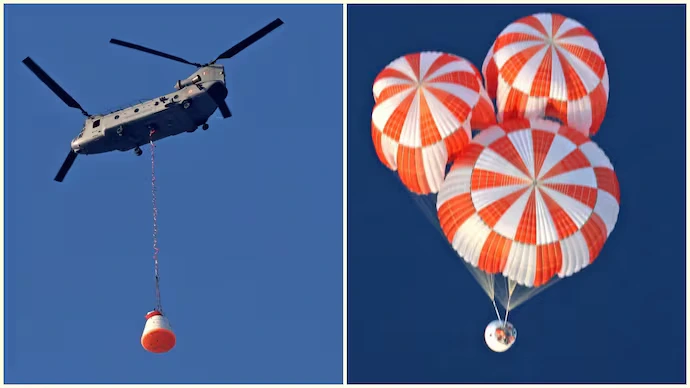
The Indian Space Research Organisation (Isro) has announced that it has completed the second Integrated Air Drop Test for the Gaganyaan mission. The event took place on April 10, 2026, at the Satish Dhawan Space Centre in Sriharikota, Andhra Pradesh, marking a significant advancement in India’s efforts to send astronauts into space. The test, known as IADT-02, was designed to simulate the re-entry and safe landing of the crew module, which is vital for the mission’s success.

The IADT-02 particularly focused on testing the parachute deployment system, which plays a key role in ensuring that the crew module descends safely. This involves a sequence of parachutes, including Apex Cover Separation parachutes, Drogue parachutes, Pilot parachutes, and Main parachutes. Each parachute’s deployment is meticulously timed to ensure maximum efficiency in slowing the module’s descent.

Significance of the Test

A successful drop test is crucial because a failure in timing or parachute deployment could result in the module impacting the water at an unsafe velocity. Therefore, multiple tests are being conducted to validate each aspect of the parachute system. The recent IADT-02 was built upon the foundations set by the first test, which successfully demonstrated the performance of the parachutes by lowering a simulated crew module weighing approximately 4.8 tonnes from an altitude of approximately three kilometres.

The Gaganyaan mission will consist of two primary components: a crew module that can transport up to three astronauts, and a service module. The crew module will detach upon re-entry and is designed to splash down in the ocean. This segment of the test is instrumental in ensuring that all systems are functional and the safety of future crew members is guaranteed.

Future Plans for the Gaganyaan Mission

In preparation for the Gaganyaan mission, the Indian government has outlined plans for three uncrewed test flights before the inaugural crewed flight slated for 2027. The first uncrewed flight is anticipated to take place in 2026 and will carry a humanoid robot named Vyommitra. This robot is designed to simulate crew functions and will monitor conditions inside the spacecraft during the test.

Overall, the Gaganyaan programme involves collaborative efforts from various agencies, including the Defence Research and Development Organisation (DRDO), the Indian Air Force, the Indian Navy, and the Coast Guard. Further tests are already being planned to validate the system’s performance comprehensively, following the recent success of IADT-02.

If the mission proceeds as planned, India intends to join a select group of countries, becoming the fourth nation globally to independently launch humans into space, following in the footsteps of Russia, the United States, and China. The advancements made in Gaganyaan represent a significant milestone for India’s space exploration ambitions.

Long or Short, get news the way you like. No ads. No redirections. Download Newspin and Stay Alert, The CSR Journal Mobile app, for fast, crisp, clean updates!

App Store –  https://apps.apple.com/in/app/newspin/id6746449540 

Google Play Store – https://play.google.com/store/apps/details?id=com.inventifweb.newspin&pcampaignid=web_share

Latest News

Popular Videos
