


Guidance on Selecting the Appropriate ITR Form for AY 2026-27
The CSR Journal Magazine

Determining the correct Income Tax Return (ITR) form is crucial for taxpayers to avoid rejections or delays in their submissions. Each form serves a distinct purpose, reflecting the various income types and structures that individuals may have. With the proper understanding, taxpayers can navigate this often complex landscape more easily.

The Central Board of Direct Taxes (CBDT) has issued guidelines for the financial year 2025-26, detailing all seven available ITR forms. It is essential for taxpayers to identify the form that aligns with their income sources, overall earnings, and tax categories before initiating the filing process.

A critical factor in this decision is that the ITR form conveys specific information to the tax authorities regarding an individual’s income sources, whether those are salary, business profits, capital gains, or other types. Incorrect filings can lead to regulatory scrutiny, thus emphasising the need for precision in form selection.

Overview of Common ITR Forms

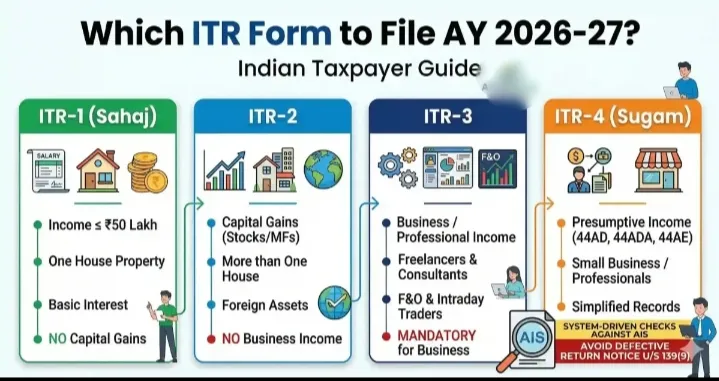
ITR-1, also known as Sahaj, is designed for individuals whose financial affairs are relatively straightforward. This form is suitable for those earning a salary or pension, whose total income does not exceed Rs 50 lakh, and who may have limited income from house property or small interest earnings. However, if one’s income situation is more complicated, such as involving foreign assets or significant agricultural income, this form may not be the best fit.

ITR-2 is applicable for individuals who earn capital gains or have foreign income but do not run a business. Such taxpayers may include non-residents or those with diverse income streams, including lottery winnings. Unlike ITR-1, this form has no upper limit on income, making it ideal for taxpayers with higher earnings from non-business ventures.

For entrepreneurs and professionals, ITR-3 is the recommended form. This encompasses those whose earnings are derived from business activities as well as any supplementary income from salaries, house properties, or additional sources. ITR-3 requires more detailed disclosures to accommodate the complexities associated with professional and business income.

ITR Forms for Specific Circumstances

ITR-4, often referred to as Sugam, targets small taxpayers opting for a presumptive taxation scheme. This form suits individual taxpayers, Hindu Undivided Families (HUFs), and select partnerships with earnings up to Rs 50 lakh. Small business owners and freelancers commonly utilise this form, allowing them to declare income based on a fixed rate without maintaining exhaustive financial records.

The submission deadline for most taxpayers is July 31, 2026. Timely filing is crucial to avoid potential penalties, making it advisable for individuals to prepare their taxes well in advance. Understanding the full range of ITR forms leads to more informed decisions and smoother submission processes, regardless of the complexity of one’s financial situation.

Engaging with the precise ITR form is a foundational aspect of hassle-free tax filing. Taxpayers are encouraged to take the necessary time to assess their income sources accurately, ensuring that they select the most appropriate form. While the initial process may seem daunting, clarity regarding one’s financial details simplifies the decision significantly.

Long or Short, get news the way you like. No ads. No redirections. Download Newspin and Stay Alert, The CSR Journal Mobile app, for fast, crisp, clean updates!

App Store –  https://apps.apple.com/in/app/newspin/id6746449540 

Google Play Store – https://play.google.com/store/apps/details?id=com.inventifweb.newspin&pcampaignid=web_share

Latest News

Popular Videos
