


Rent, Food, Salary: Tier-1 vs Tier-2 Cities Cost of Living Breakdown
The CSR Journal Magazine

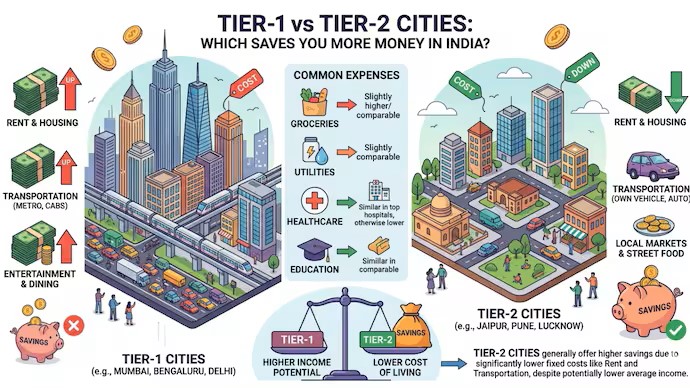
The comparison between Tier-1 and Tier-2 cities in India reveals significant differences in housing and living expenses. In major cities like Mumbai, Delhi, and Bengaluru, the monthly rent for a one or two-bedroom flat typically ranges from Rs 25,000 to over Rs 50,000. Purchasing property in these urban centres can extend into crores of rupees. In contrast, similar accommodations in Tier-2 cities such as Indore, Nagpur, Surat, and Jaipur are considerably more affordable, with rentals between Rs 8,000 and Rs 20,000.

The disparity in costs extends to food and dining as well. A meal at a mid-range restaurant in Tier-1 cities usually costs between Rs 600 and Rs 1,000 per person, while in Tier-2 cities, the same meal can be enjoyed for Rs 300 to Rs 600. Overall, groceries and daily necessities in Tier-1 cities are reported to be 20-40 per cent more expensive than in their Tier-2 counterparts.

The costs associated with utilities like electricity further illustrate the financial differences. In metropolitan areas, electricity rates can reach up to Rs 10 per unit, while in Tier-2 cities, rates generally fall between Rs 5 and Rs 7 per unit. Transportation services and daily expenses are also noted to be less expensive in smaller cities.

Income and Savings Potential

It is evident that salaries in Tier-1 cities tend to be 30-50 per cent higher, particularly in sectors like IT, finance, and corporate jobs. However, the increased income does not necessarily translate to higher savings for residents. After accounting for essential expenses such as rent, food, and transport, many individuals find that their discretionary income diminishes substantially. Reports indicate that residents in Tier-2 cities are able to retain a larger portion of their income due to lower living costs.

Comparative studies from 2026 suggest that individuals residing in Tier-2 cities can save more, as their financial obligations are less burdensome. The key takeaway is that, despite the disparity in earnings, the overall cost of living in smaller cities allows for more effective financial management.

The emphasis on salary versus savings highlights a complex decision for many individuals. While a higher salary may appear attractive, it is crucial to consider the overall affordability of living conditions and the ability to save for future needs.

Quality of Life Considerations

Quality of life in Tier-1 cities is often associated with better job opportunities and advanced infrastructure. Residents benefit from improved connectivity and access to top-tier schools and healthcare facilities. However, these advantages come with drawbacks such as significant traffic congestion, overcrowded public spaces, and elevated living expenses.

On the other hand, Tier-2 cities provide a simplified lifestyle with lower housing costs and reduced congestion. The pace of life is generally slower, making these locations appealing for individuals seeking affordability and tranquillity. While there are fewer high-end services and specialised job roles available in Tier-2 cities, the overall lifestyle can be more appealing for those prioritising cost savings.

Ultimately, the choice between Tier-1 and Tier-2 cities hinges on individual priorities. Those looking for higher earnings and diverse job opportunities may favour large metropolitan areas, while those more concerned with savings and a relaxed lifestyle might choose smaller cities. Each option comes with its own set of trade-offs that potential residents must carefully consider.

Long or Short, get news the way you like. No ads. No redirections. Download Newspin and Stay Alert, The CSR Journal Mobile app, for fast, crisp, clean updates!

App Store –  https://apps.apple.com/in/app/newspin/id6746449540 

Google Play Store – https://play.google.com/store/apps/details?id=com.inventifweb.newspin&pcampaignid=web_share

Latest News

Popular Videos
