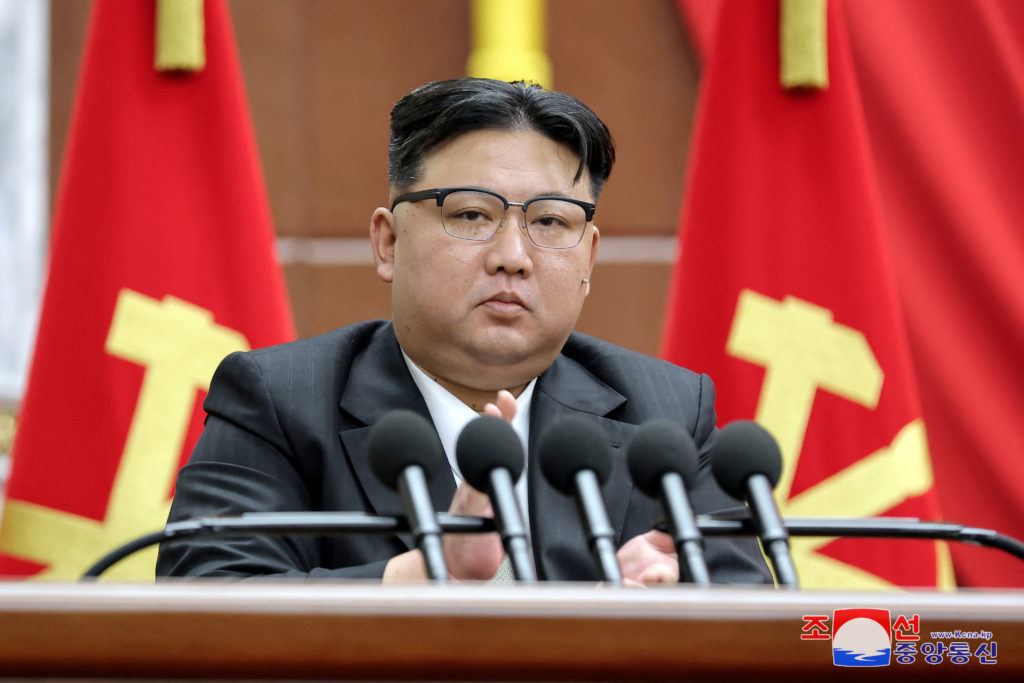
North Korean leader Kim Jong Un attends the 8th Plenary Meeting of the 8th Central Committee of the Workers' Party of Korea, at the party's headquarters, in Pyongyang, North Korea, in this picture released by the Korean Central News Agency on December 31, 2023. KCNA via REUTERS ATTENTION EDITORS - THIS IMAGE WAS PROVIDED BY A THIRD PARTY. REUTERS IS UNABLE TO INDEPENDENTLY VERIFY THIS IMAGE. NO THIRD PARTY SALES. SOUTH KOREA OUT. NO COMMERCIAL OR EDITORIAL SALES IN SOUTH KOREA.
Kim Jong Un continues to assert his authority over North Korea through a stringent regime, marked by significant human rights abuses and widespread poverty. His government maintains one of the world’s most reclusive and isolated political systems. Recent actions, including missile launches from naval destroyers, underline a commitment to showcasing military capabilities. While Kim’s leadership style is often condemned, the rationale behind his nuclear strategy invites scrutiny.
Historical Context of Nuclear Deterrence
Kim Jong Un’s argument emphasizes that lacking nuclear weaponry positions a nation as a potential target for foreign intervention, particularly from the United States. He points to historical precedents where nations without nuclear capabilities, like Iraq, were subjected to military invasions. Despite no evidence of weapons being present, Iraq became a focal point for US military action, leading to substantial loss of life and resources. This history contributes to the perception that nations might require nuclear deterrents for self-preservation.
The case of Libya further exemplifies the dangers of disarmament. Muammar Gaddafi dismantled his nuclear programme in 2003, believing this would prevent Western aggression, only to face a NATO-led military operation in 2011. Gaddafi’s death starkly illustrates the volatility surrounding nations perceived as vulnerable. His son’s later regret over the decision to forgo nuclear capabilities emphasises the perceived risks of disarming in an unpredictable geopolitical landscape.
Similarly, Iran has faced military actions amidst its nuclear ambitions, despite never advancing to weapon development. In 2026, US and Israeli military operations targeted Iran directly, underlining the reality that being devoid of nuclear weapons does not equate to safety. The understanding of deterrence, according to various analysts, indicates that countries equipped with nuclear arsenals are less likely to experience military interventions.
Impacts of Nuclear Policies on Global Politics
North Korea’s stance on nuclear armament reflects a broader trend observed in nations that have felt threatened by international powers. Kim Jong Un noted the outcomes of military engagements in other nations to justify North Korea’s advancements in nuclear technology. During a speech to the Supreme People’s Assembly, he reaffirmed the nation’s unwavering commitment to its nuclear status, labelled as irretrievable by the regime.
India experienced a similar evolution in its strategic nuclear policy following military confrontations with China. After facing significant setbacks, India developed its nuclear programme covertly, leading to a successful test in 1974. Subsequent advancements culminated in further tests in 1998. India’s approach helped establish its status as a nuclear power, reinforcing security and complicating external interference, particularly from the United States.
The global landscape has shifted as nations reassess their nuclear policies in light of perceived threats. The United States, after investing significant resources, approximately $1.7 trillion over three decades—to modernise its nuclear arsenal, has inadvertently contributed to an arms race dynamic. Countries such as Germany and Saudi Arabia have signalled intentions to explore their own nuclear capabilities in response to regional threats, further illustrating the cyclical nature of nuclear deterrence as a means of securing national interests.
Conclusion on Kim Jong Un’s Position
In summary, while Kim Jong Un’s leadership is frequently associated with brutality and oppressive measures, the justification for North Korea’s nuclear programme presents a complex layer within global politics. Historical examples serve to highlight the role of nuclear weapons in ensuring state survival. As nations continue to observe the shifting dynamics of international relations and military strategies, the implications of nuclear arsenals remain pertinent. The discourse surrounding deterrence lingers, affirming its significance in contemporary geopolitics.
Long or Short, get news the way you like. No ads. No redirections. Download Newspin and Stay Alert, The CSR Journal Mobile app, for fast, crisp, clean updates!
Ajay Devgn has recently added a distinctive vehicle to his collection, characterised by its luxurious features. This car reportedly includes massage seats, providing an...
Croma has initiated its Everything Apple sale, providing customers with substantial discounts on a variety of Apple products. This sale will be held in...