


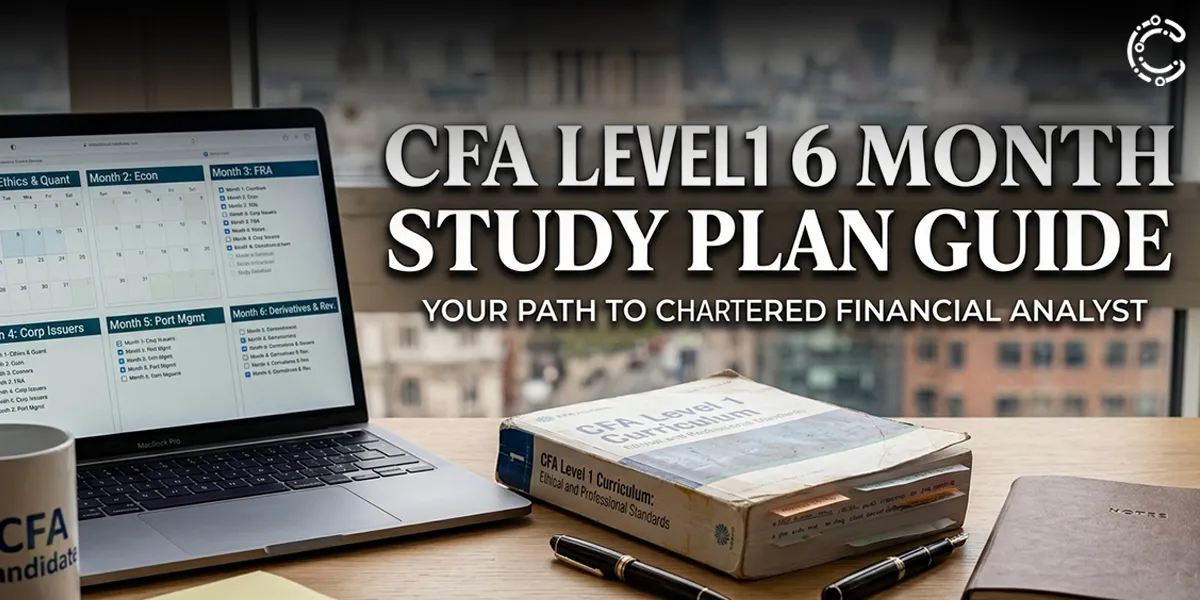

Most people start studying for the CFA the way they start a gym membership. High energy, no plan. They open the first chapter, read every page with equal respect and three months later they have polished topics that barely appear on the paper while the heavy ones remain untouched.
You can avoid this by taking a quick look at the CFA course details before buying a single book. The structure of the test should influence the structure of your study. How many questions, how the sessions go, which subjects have the marks. Below is a way to turn those facts into a plan, whether you’re fresh out of college or fitting sessions around a full-time job.
CFA Course Details Worth Knowing Before You Commit
1. Three Levels, Ten Subjects
The programme is split into three levels, and most candidates allow six months for each. There are 10 core subjects, but the coverage and emphasis vary between levels. And by the time you get to Level 3, they start to talk less about calculations or returns and more about creating investment portfolios.
2. Who Can Register
Eligibility is looser than a lot of people assume. A final-year bachelor’s student can register, and so can someone who already holds the degree, in any discipline. Work experience in finance may count in place of the degree.
3. The Prerequisite Readings
Before taking the Level 1 exam, the CFA Institute provides preparatory readings on quantitative techniques, economics, and analysing financial reports. Though none of this content is tested directly, if you feel out of practice, it would be unwise not to read these documents, as this material will be important to know when going through the rest of the syllabus.
4. The Practical Skills Module
One more thing catches candidates off guard. Every level includes a practical skills module that takes 10 to 15 hours, and at least one has to be finished before the result is released. At Level 1, the options are financial modelling, which has you build a three-statement model, or Python for finance. Analyst teams are asking for both more often, so this is time well spent, not a box to tick.
How the CFA Level 1 Paper Is Built
The CFA exam at Level 1 runs in two sessions. Each has 90 multiple-choice questions and 135 minutes, with an optional 30-minute break in between. There’s no negative marking.
Do the sums. That’s 180 questions in 270 minutes, roughly 90 seconds each. The pace feels harsh in your first mock and normal by your fifth. And since wrong answers cost nothing, a blank is simply a lost chance.
The workload is heavy too. The CFA Institute recommends 300 hours of study per level. Spread over six months, that’s roughly 12 hours a week, which leaves no room to give equal time to topics that aren’t equally weighted.
CFA Topic Weights: Where the Marks Sit
Subject |
Weight at Level 1 |
Ethical and Professional Standards |
15 to 20% |
Financial Statement Analysis |
11 to 14% |
Equity Investments |
11 to 14% |
Fixed Income |
11 to 14% |
Portfolio Management |
8 to 12% |
Alternative Investments |
7 to 10% |
Quantitative Methods |
6 to 9% |
Economics |
6 to 9% |
Corporate Issuers |
6 to 9% |
Derivatives |
5 to 8% |
Of all the CFA course details, these weights are the most useful. Add up ethics, financial statements, equities and fixed income and four subjects hold 48% to 62% of the paper. Derivatives, which frightens plenty of candidates, are 5% to 8% at most.
Ethical standards need special attention while preparing, as they carry the highest weightage in the syllabus; give proper revision, as this unit alone can help you get a good score.
What sits inside the big blocks:
-
Financial statement analysis: income statements, balance sheets, cash flows, reporting quality
-
Fixed income: bond pricing, yields, duration, credit risk
-
Equity investments: market structure, company and industry analysis, basic valuation
-
Portfolio management: risk and return, planning, behavioural biases
Turning Weights Into a Six-Month Plan
Start from the date, not the book. Level 1 takes place four times a year, in the months of February, May, August, and November. The early registration deadline is a good way ahead of the normal one, so select your time slot and then go back six months from that date.
Then split your hours roughly in line with the weights and tilt them toward your weak spots. A commerce graduate who’s comfortable with accounting can trim financial statements a little and hand those hours to quant and derivatives. An engineer might do the reverse.
One shape that works:
-
Month 1: prerequisite readings, quantitative methods, economics
-
Months 2 to 4: financial statements, corporate issuers, equity, fixed income, derivatives, with questions after every topic
-
Every week: an hour or two of ethics, little and often
-
Month 5: portfolio management, alternatives, a full review of weak topics
-
Month 6: timed full mocks, each one reviewed properly
Try one mock earlier than feels comfortable, even if the score stings. Sit it in the real two-session format, as you would on the day of the CFA exam, and your errors will show which topics need extra hours while there’s still time to give them.
Make CFA Preparation More Manageable with Imarticus Learning
Planning alone is hard when work and life keep interrupting, which is why structured programmes exist. Imarticus Learning is India’s first and only approved CFA Institute prep provider, and its programme follows the same ideas covered above.
-
Six months per level across 3 levels, at 20+ centres or live online
-
Kaplan Schweser books, notes, question banks and mocks for every level
-
A dual teacher model: charterholder faculty teach live, while a second teacher handles one-on-one doubts 24×7
-
iLeap, its study platform, includes an AI tutor that explains any topic when you hit a wall, day or night
-
A pass guarantee, with a 50% fee refund if a level isn’t cleared
-
12 live practical sessions a year led by KPMG in India professionals, plus a joint certification
-
A pre-placement bootcamp after Level 1 with mentorship, resume building and mock interviews