


Tesla Unveils Roadster Rocket Package Powered by SpaceX Thruster Tech
The CSR Journal Magazine

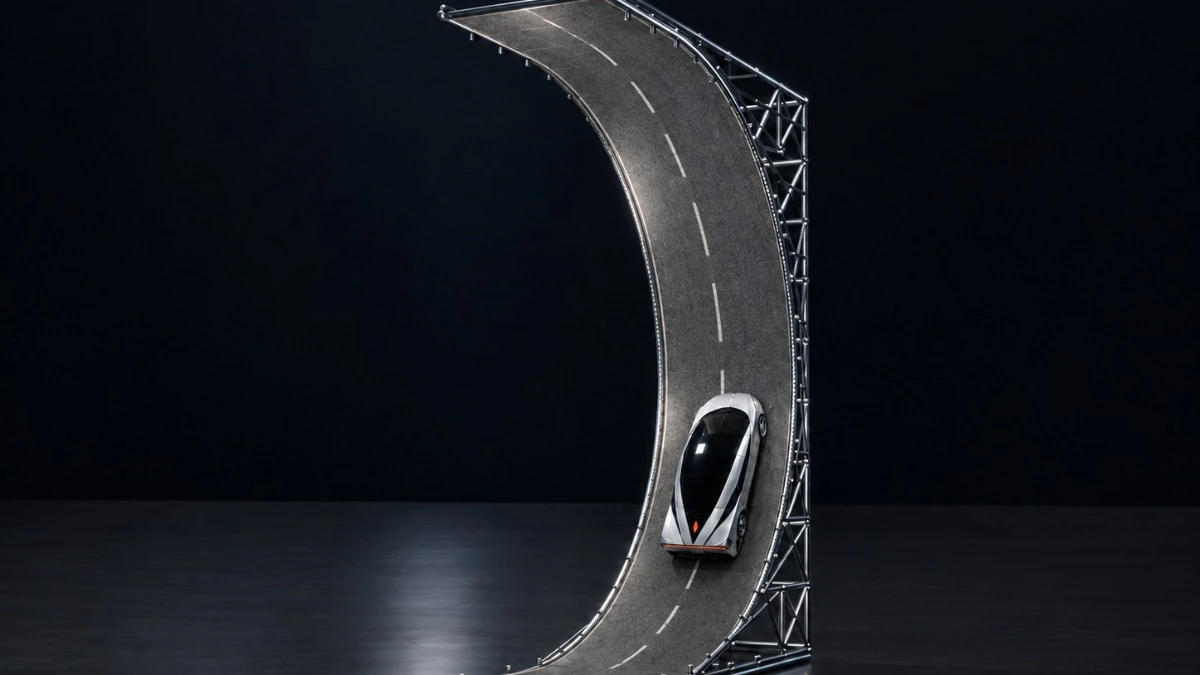
Tesla recently showcased its innovative Roadster in a live demonstration, where the vehicle performed an impressive upside-down flip on a curved ramp. This event took place on Thursday night and was orchestrated by billionaire entrepreneur Elon Musk, who is known for his ventures in both electric vehicles and space exploration through Tesla and SpaceX.

The demonstration featured multiple versions of the Roadster, including the standard model, Roadster Performance, Roadster Thrust, and the top-tier Roadster Rocket. The Rocket version is particularly notable for incorporating SpaceX’s rocket technology, which includes a sophisticated thruster system designed to enhance the vehicle’s performance.

During the event, Musk expressed enthusiasm about the capabilities of the Roadster, stating that the vehicle’s design allows it to perform aerial maneuvers without the need for special fuel. The demonstration aimed to highlight the vehicle’s innovative features and the potential for future advancements in automotive technology.

Mechanics Behind the Roadster’s Performance

The Roadster Rocket employs three distinct systems to achieve its remarkable performance. One system is responsible for propulsion, another for lifting and steering, and the third maintains the vehicle’s stability on the ground. This complex interaction enables the Roadster to execute aerial flips and land safely, showcasing Tesla’s engineering prowess.

To explain the mechanics, Musk likened the propulsion to releasing an untied balloon, where the air rushes out and propels the balloon forward. The Roadster Rocket features four rear nozzles that expel air at supersonic speeds, a process described by Tesla’s chief vehicle engineer, Lars Moravy, as a “cold gas” thruster system. This method avoids combustion, making it a safer alternative for propulsion.

In addition to the rear thrusters, the Rocket version is equipped with additional thrusters around its body to assist in lifting and steering during flight. The design includes fans that draw air from beneath the vehicle, creating a vacuum effect that helps to stabilise the car against the road surface. Tesla claims this system can exert a downward force equivalent to twice the vehicle’s weight.

Future Prospects and Challenges

Elon Musk has previously mentioned that the Roadster will utilise SpaceX’s cold-gas thrusters powered by ultra-high-pressure air stored in specially designed tanks. The Rocket version’s air tanks have a combined capacity of 600 litres, and the air is compressed to a pressure of 5,500 psi, significantly higher than that of a typical CNG cylinder.

Performance metrics indicate that the Roadster can accelerate from 0 to 96 km/h in just 0.81 seconds for the Thrust version and 0.59 seconds for the Rocket version. The thrust produced is reported to be 80 kN, sufficient to support a weight of over 8,000 kg. However, the vehicle’s operation relies heavily on advanced sensors and computer systems that make rapid adjustments to maintain stability and control.

Despite the impressive demonstration, Musk has acknowledged that the Roadster is “not necessarily a safety-optimised car.” The vehicle’s design and functionality still require rigorous testing and validation to ensure it meets safety standards for public roads. The anticipated production date for the Roadster is set for 2028, and it remains to be seen whether this ambitious project will transition from concept to a commercially viable product.

Long or Short, get news the way you like. No ads. No redirections. Download Newspin and Stay Alert, The CSR Journal Mobile app, for fast, crisp, clean updates!

App Store – https://apps.apple.com/in/app/newspin/id6746449540

Google Play Store – https://play.google.com/store/apps/details?id=com.inventifweb.newspin&pcampaignid=web_share

Latest News

Popular Videos
